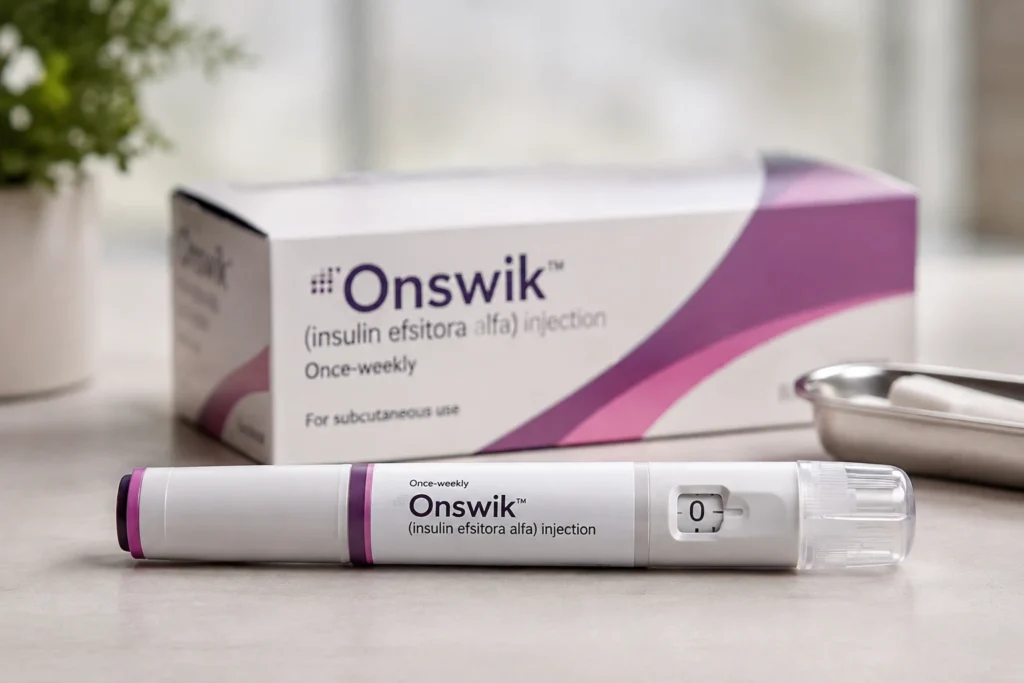
Long-acting insulin approved for type 2 diabetes
Practice Nurse 2026;56(5): online only
The Medicines and Healthcare products Regulatory Agency (MHRA) announced this week (13 October 2026) that Onswik (insulin efsitora alfa) has been authorised for the treatment of type 2 diabetes in adults.
Insulin efsitora alfa, a long-acting basal insulin, is administered via injection once weekly. For those with type 2 diabetes, this treatment option reduces the number of injections required from 365 a year to 52.
The new insulin was accepted by NICE earlier this year, but until now, was not licensed for UK use.
Julian Beach, MHRA Executive Director of Healthcare Quality and Access, said
The authorisation followed a rigorous assessment of the available evidence.
‘Clinical trial data showed that once-weekly insulin efsitora alfa provided glycaemic control comparable to once-daily basal insulin treatments in adults with type 2 diabetes.’
Onswik has also been shown to have with similar rates of hypoglycaemic events when compared to both insulin degludec and insulin glargine. People taking Onswik also required a lower weekly insulin dose and fewer dose adjustments compared with those on daily insulin.
While Onswik could be considered for patients with type 2 diabetes who need to switch from Levemir – which has been discontinued, with supplies expected to be exhausted by the end of the year – it is not directly comparable. Levemir is a daily basal insulin that often requires administration twice daily to provide steady, 24-hour background coverage. Onswik is an ultra-long-acting insulin analog designed to release steadily over a full seven days from a single injection. Importantly, it is not licensed for use in patients with type 1 diabetes.
However, the need to switch patients on Levemir to an alternative insulin is becoming increasingly urgent, as around the country, thousands of patients are still using Levemir and pharmacies are beginning to report intermittent supply problems.
The RCGP has warned that supplies of Humulin I and Abasaglar cannot support a significant increase in demand and should not be routinely used unless there is a clear clinical need.
Association of British Clinical Diabetologists (ABCD) guidance states that alternative insulins should be chosen after careful clinical review, with follow-up arranged to adjust the dose if required.
Related news
View all News