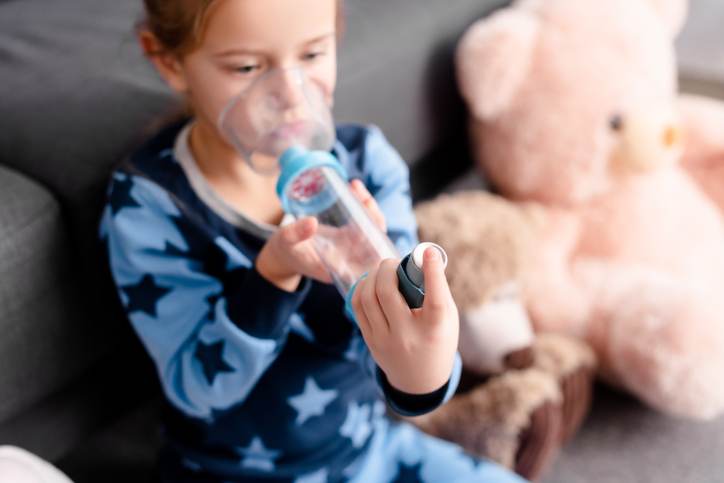
Asthma management and assessment in very young children
INTRODUCTION
Historically, it has been considered difficult to diagnose asthma in children aged 5 years or under, and therefore management can also be challenging.
However, the goals of management in young children are similar to those in any other patient living with asthma:
- To achieve the best possible control of symptoms and maintain normal activity levels
- To minimise the risk of exacerbations, impaired lung development and medication side effects
This module aims to enhance and test your knowledge of the principles of assessment and management in young children, based on the 2026 update of the Global Initiative for Asthma report.
LEARNING OBJECTIVES
On completion of this resource, you should have a clearer understanding of:
- Diagnostic criteria for asthma in under 5s
- Assessment of asthma symptom control and future risk of adverse outcomes
- Choosing medications for children 5 years and younger
- When to seek specialist advice
This module is offered at an intermediate level. Read the accompanying article then answer the five assessment questions, then download the certificate of completion. You should record the time spent on this activity for your CPD portfolio.
Practice Nurse featured articles
GINA 2026: Achieving the best possible outcomes for people with asthma – Guideline in a Nutshell.
Management of asthma in children under 5: GINA 2025 – Guideline in a Nutshell.
Contents
The goals of asthma management are to prevent asthma deaths and reduce the burden of asthma on individuals, families and health systems and, for the individual, to achieve long-term asthma control, including:
- Few/no asthma symptoms
- No sleep disturbance due to asthma
- Unimpaired physical activity
- No exacerbations
- Improved or stable personal best lung function
- No requirement for maintenance oral corticosteroids, and
- No medication side-effects
Diagnosis
Failure to confirm a diagnosis of asthma risks unnecessary treatment for those who do not have the condition, or missed diagnoses of other serious conditions, the latest update to GINA asthma guidelines warns.
The diagnosis of asthma in young children is made by confirming a pattern of recurrent asthma-like symptoms, with careful consideration of the differential diagnosis (Table 1), and confirming treatment response. A structured approach is recommended, based on the presence of three criteria:
- Recurrent acute wheezing episodes OR at least 1 acute wheezing episode with asthma-like symptoms between episodes
- No likely alternative cause for the respiratory symptoms
- Timely response of respiratory symptoms or signs to asthma medications, e.g. short-term response during acute wheezing episode (at home or in the clinic) to short-acting beta agonist (SABA) within minutes; reduced frequency or severity of acute wheezing episodes and/or symptoms between episodes during 2-3 months’ trial for daily inhaled corticosteroids (ICS)
All three criteria must be met to confirm the diagnosis of asthma. If only 1 or 2 criteria are met, describe the child’s condition as ‘suspected asthma’.
Wheeze that can be heard without a stethoscope is the most common and specific sign associated with asthma in children 5 years or under. Wheeze that occurs during sleep or which is triggered by activity, laughing or crying is consistent with asthma. It is defined as a high-pitched sound on expiration, but parents may use the word to describe any noisy or difficult breathing.
Other typical symptoms include dry, recurrent or persistent cough (but may be due to allergic rhinitis, the common cold or other respiratory infections, including whooping cough), breathlessness and avoidance of strenuous play or exercise.
TABLE 1. COMMON DIFFERENTIAL DIAGNOSES IN CHILDREN £5 YEARS | |
If these symptoms or signs are present, consider | Condition |
Mainly cough and runny congested nose for <10 days, without wheezing or difficulty breathing | Viral upper respiratory tract infection (URTI) |
Cough when feeding, recurrent chest infections | Gastroesophageal reflux +/- pharyngeal dysphagia |
Sudden onset of symptoms, unilateral wheeze | Inhaled foreign body Other conditions including tuberculosis |
Protracted paroxysms of coughing, often with stridor and vomiting | Pertussis |
Persistent wet cough | Protracted bacterial bronchitis Tuberculosis |
Noisy breathing when crying or eating; harsh cough | Tracheomalacia (collapsed airway resulting from structural weakness of the trachea) |
Cardiac murmurs, failure to thrive | Congenital heart disease |
Pre-term delivery, symptoms since birth | Bronchopulmonary dysplasia |
Excessive cough and mucus production, gastrointestinal symptoms, failure to thrive | Cystic fibrosis |
Cough and recurrent chest infections; neonatal respiratory distress, chronic ear infections and persistent nasal discharge from birth | Primary ciliary dyskinesia (malfunctioning cilia in the upper respiratory tract) |
Noisy breathing, feeding difficulties | Vascular ring (congenital heart defect) |
Assessing symptoms and control
Assessing asthma control depends on reports from parents/carers, who may not always be aware of the frequency or severity of symptoms, or mistake them as tiredness, irritability or mood changes, not recognising that they represent uncontrolled asthma.
The Childhood Asthma Control Test (cACT) can be used for children aged 4–11 years, and GINA has developed a set of questions for use in children aged 5 and under (Table 2).
TABLE 2. ASSESSING SYMPTOM CONTROL IN CHILDREN >5 YEARS | |||
Recent symptom control | Level of asthma symptom control | ||
In the past 4 weeks, has the child had: | Well controlled | Partly controlled | Uncontrolled |
Daytime asthma symptoms more than twice a week? | None of these | 1–2 of these | 3-4 of these |
Any night waking or night-time coughing due to asthma? | |||
SABA medication needed more than twice a week? | |||
Any activity limitation due to asthma? (Runs/plays less than other children, tires easily when walking/playing?) | |||
Risk factors for future asthma exacerbations include one or more severe acute episodes needing emergency visit, inpatient treatment or OCS in the past year; uncontrolled asthma symptoms; exposure to tobacco smoke, indoor or outdoor pollution, or indoor allergens; major psychological or socio-economic problems for the child or family; poor adherence to ICS or incorrect inhaler technique.
Good control of asthma can be achieved in almost all young children.
Consider:
- The preferred medication option at each treatment step to control asthma symptoms and minimise future risk
- Response to previous treatment
- Patient characteristics that contribute to symptoms or risk of flare-ups, including
- Clinical phenotype
- Comorbidities including allergic rhinitis
- Environment exposures, such as passive smoking
- Parent/carer preferences (goals, beliefs and concerns about medications)
- Practical issues such as inhaler technique and adherence
GINA recommends a stepwise approach, based on symptom control, risk of exacerbations and side effects, and response to initial treatment. Generally, treatment for preschool children includes long-term daily use of low-dose ICS to maintain good asthma control. Initially, treatment should be given for 2–3 months to establish effectiveness(See Table 3). Children aged 5 years or less should be provided with SABA for as-needed symptom relief, by pMDI with mouthpiece or face mask as appropriate (Table 4).
- If a child needs more than 4 puffs of salbutamol in less than 4 hours, urgent medical care should be sought.
Management
The goals of treatment in young children are similar to those in older patients:
- To achieve the best possible control of symptoms and maintain normal activity levels
- To minimise the risk of exacerbations, impaired lung development and medication side-effects
TABLE 3. ASTHMA MEDICATION OPTIONS FOR CHILDREN >5 YEARS | |||
STEP 1 (Insufficient evidence for daily controller) | STEP 2 Daily low dose ICS | STEP 3 Double ‘low dose’ ICS | STEP 4 Continue controller and refer for expert assessment |
Intermittent short course ICS at onset of viral illness | Daily leukotriene receptor antagonist (LTRA) or intermittent short course ICS at onset of respiratory illness | Consider referral for expert assessment | |
As-needed short-acting beta2-agonist | |||
Consider this step for children with: | |||
Infrequent acute wheezing (e.g. virus-induced) and no or minimal asthma symptoms in between episodes | Asthma symptoms not well controlled or one or more severe exacerbations in the past year | Asthma not well controlled on low dose ICS | Asthma not well controlled on Step 3 ICS |
Before stepping up, check for alternative diagnoses, inhaler skills, adherence and exposures | |||
Once the diagnosis of asthma is confirmed, establish the minimal effective dose for each patient that controls their interval symptoms, and in combination with an action plan, reduces the risk of acute episodes and the need for oral corticosteroids. For dosing, consult the summary of product characteristics for each individual product.
In young children with persistent asthma, regular treatment with an LTRA may help to reduce symptoms, but daily ICS has been shown to be more effective in improving symptoms and reducing exacerbations than regular LTRA monotherapy. Parents/carers should be warned about the potential adverse effects on montelukast on sleep and behaviour.
TABLE 4. INHALER DEVICES FOR CHILDREN 5 YEARS AND YOUNGER | ||
Age | Preferred device | Alternative device |
0–3 years | pMDI plus dedicated spacer with face mask | Nebuliser with face mask |
4–5 years | pMDI plus spacer with mouthpiece | pMDI plus spacer with face mask |
Technique with pMDI and spacer | ||
Give the inhaled medication, one puff at a time. For salbutamol, shake the inhaler immediately before each puff. Encourage the child to take 5–6 breaths from the spacer after each puff | ||
Referral for specialist advice
Any of the following features in a child <5 years should prompt referral for specialist advice
- Failure to thrive
- Neonatal/very early onset of symptoms
- Vomiting associated with respiratory symptoms
- Continuous wheezing, recurrent stridor or barking cough
- Failure to respond to asthma medications (ICS, oral steroids or SABA)
- No association of symptoms with typical triggers, e.g., viral URTI
- Focal lung or cardiovascular signs, finger clubbing
- Hypoxemia (<95%)
Global Initiative for Asthma. Global strategy for asthma management and prevention, 2026. https://ginasthma.org/2026-gina-strategy-report/
Related modules
View all Modules