
BEATing heart failure: a whole-system community-based approach
Dr Alexander D’Elia, GP and NIHR Clinical Lecturer, University of Birmingham | Amy Newton, Global Sustainability Director, Medtronic, Watford | Dr Nick Hartshorne-Evans BEM, CEO Pumping Marvellous Foundation, Preston | Dr Rajiv Sankaranarayanan, Consultant Cardiologist, Honorary Associate Professor, University of Liverpool; Pumping Marvellous Foundation Clinical Advisory Board | Professor Clare J Taylor, GP, Professor of General Practice, University of Birmingham; Pumping Marvellous Foundation Clinical Advisory Board
Practice Nurse 2026;56(6):12-15
The BEAT HF campaign enables case-finding, diagnosis and management of heart failure in a bid to prevent adverse outcomes and improve overall survival
Heart failure is a clinical syndrome which affects more than 64 million people globally with rates predicted to increase due to ageing and population growth.1,2 In the UK, there are around one million people living with heart failure and around 200,000 people are newly diagnosed each year.2
Recent NICE guidance expands the recommendations for effective medications for all heart failure subtypes: heart failure with reduced ejection fraction (HFrEF), heart failure with mildly reduced ejection fraction (HFmrEF) and heart failure with preserved ejection fraction (HFpEF). The full NICE guideline update and the implications for primary care were recently discussed in Practice Nurse, in the article, Heart failure: a roadmap for diagnosis and management in primary care.3
Making a timely diagnosis is essential if patients are to receive these lifesaving therapies. Our previous work found that diagnosis in the community, in contrast to diagnosis during emergency admission to hospital, enables earlier treatment initiation, prevents adverse outcomes and is correlated with higher survival.4,5 Despite this, up to 80% of patients in the UK are diagnosed following unplanned hospitalisation, even though around 40% have already presented to primary care with symptoms of heart failure in the preceding year.6 This delay, or missed opportunity for early diagnosis and management, is likely a consequence of insidious onset, lack of symptom awareness among patients and clinicians,7 and symptomatic overlap with other long-term conditions which often coexist.8 Symptoms of heart failure include breathlessness, exhaustion and ankle swelling, and blood testing for NT-proBNP can aid diagnosis. NT-proBNP is a protein released when the heart muscle is under strain and NICE recommends testing in patients with symptoms of possible heart failure.
The Department of Health and Social Care recently published the Cardiovascular Disease Modern Services Framework, a 10-year vision for improving cardiovascular care, with a particular focus on heart failure and the importance of proactive, community-based models for ‘finding the missing millions’ of undiagnosed patients in order to initiate effective treatments and secondary prevention.9 The recent NICE guidance on heart failure similarly recommends a shift towards primary care-focused and community-based management, including increased collaboration between primary and secondary care, and improved integration of clinical pharmacists into the multidisciplinary heart failure team.10
In this article, we describe the BEAT HF campaign, including the use of the B.E.A.T. tool across four interconnected programmes. We explain how BEAT HF enables case-finding, diagnosis and management of heart failure which supports both the Cardiovascular Disease Modern Services Framework and recent NICE guidance. Finally, we demonstrate that the BEAT HF approach presents an example of a community-based, scalable and sustainable approach, ready to be applied across healthcare systems.
BEAT HF: A brief history
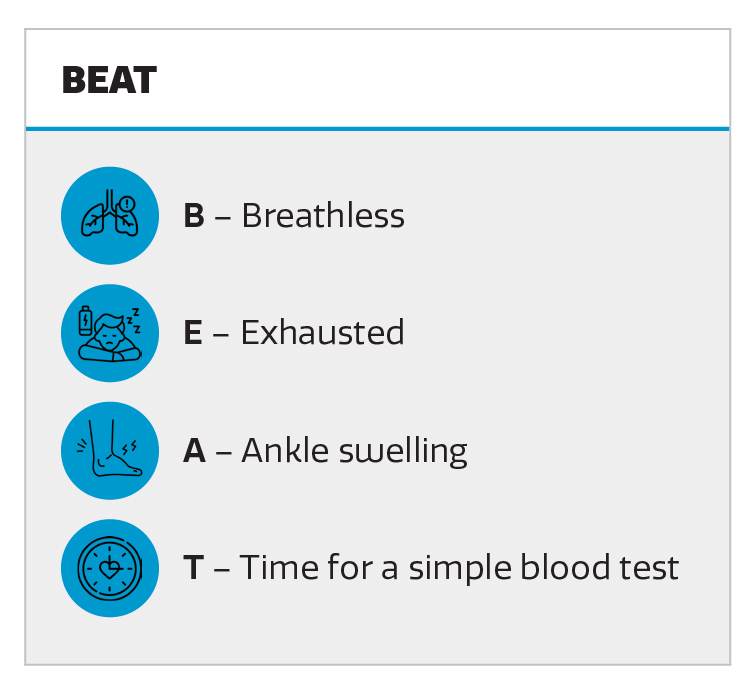
In 2018, recognising the need to raise awareness of heart failure symptoms amongst patients, the public and health care professionals, Professor Clare Taylor and the patient-led heart failure charity Pumping Marvellous Foundation created the B.E.A.T. acronym: Breathless, Exhausted, Ankle swelling, Time for a simple blood test. Analogous to the F.A.S.T. (Face, Arms, Speech, Time to call 999) tool for stroke which describes the key symptoms and what to do next, B.E.A.T. is a tool to aid early detection of heart failure in community settings. The presence of any of the B.E.A.T. symptoms should prompt consideration of NT-proBNP testing.11
The BEAT HF campaign was subsequently launched by the charity as a multi-component programme, incorporating awareness-raising, Community Heart Health events, case-finding in community settings, and a clinical pathway to primary care diagnosis and management.
- Heart failure symptom awareness
As a patient-led charity, Pumping Marvellous used patient insights and feedback to identify the barriers individuals face in recognising symptoms and accessing care. These experiences informed the development of the BEAT HF project, ensuring that campaign messaging is simple, accessible and relevant to the needs of patients and their families. The BEAT HF campaign uses eye-catching messaging to raise awareness of the common symptoms of heart failure for patients and the public, as well as healthcare professionals. This is in a variety of formats including on billboards, across social media and radio advertisements. Patient materials are also sent to NHS teams across the UK.
- Community Heart Health events
The charity also run Community Heart Health events across diverse socioeconomic locations in collaboration with the local healthcare system. Starting in 2024, Pumping Marvellous, in collaboration with local heart failure specialists, city councils, public health and primary care teams, has organised events in inclusive public spaces such as football and cricket grounds, churches and mosques, and other community venues which are easily accessible to members of the public. People over the age of 40 are invited to a free heart health check without the need for an appointment. This includes a blood pressure check (to screen for hypertension), a heart rhythm assessment (pulse check and 30 second single-lead ECG-Kardia mobile to detect atrial fibrillation) and screening for presence of any of the three B.E.A.T. symptoms. If any of these are present, the participant is offered on-site point-of-care (POC) NT-proBNP testing. Using the NICE guideline-recommended referral thresholds (≥400 pg/mL, urgent referral if >2000 pg/mL), patients with a raised result are referred to local cardiology services for HF specialist assessment, further testing (e.g. echocardiography) and diagnosis, while those with a negative result are given a letter to present to their GP for investigations into the cause of their symptoms. This also applies to new cases of atrial fibrillation or raised blood pressure.
- BEAT Pharmacies
Pharmacies are ideally placed to identify patients with symptoms of heart failure due to their accessibility, regular patient contact and integration with primary care. The BEAT Pharmacy model combines patient symptoms assessment and point of care NT-proBNP testing in symptomatic patients, to support rapid identification and referral of patients with suspected heart failure to diagnostic clinics. The initiative was recently launched in Liverpool.12
- BEAT to Treat
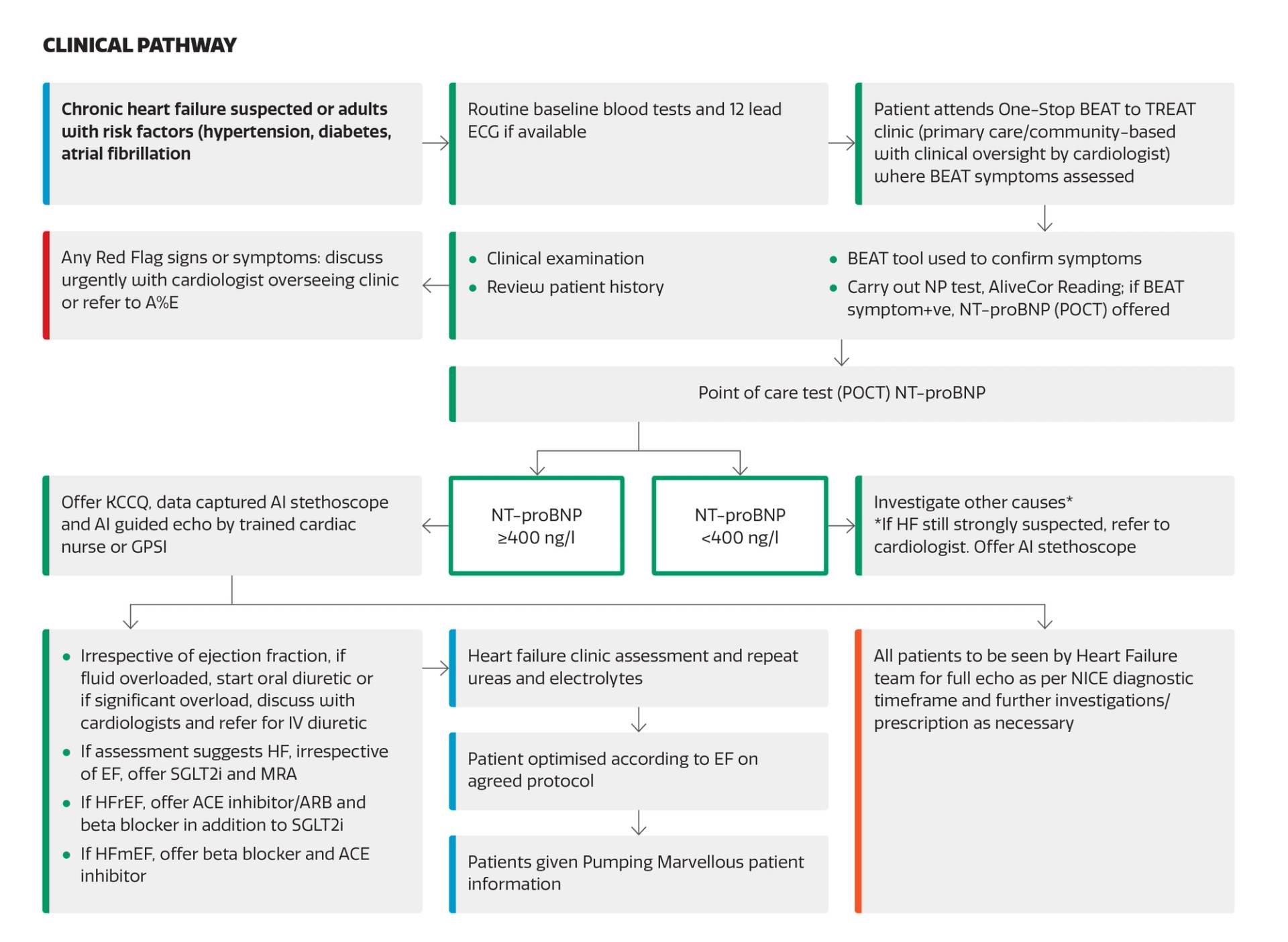
The BEAT to Treat initiative aims to enhance heart failure diagnosis and treatment in a one-stop community setting by recognising key symptoms, facilitating early detection, and expediting care (with the oversight of a heart failure cardiologist). Patients with B.E.A.T. symptoms are assessed with NT-proBNP testing, artificial intelligencen(AI)-assisted POC cardiac ultrasound (performed by a trained clinician). If heart failure is confirmed, they are started on appropriate therapies within a single 60-minute one-stop visit with a primary care clinician (with clinical oversight of a consultant heart failure cardiologist) thereby shortening waiting times from months to minutes (See Clinical Pathway, below).13,14
Impact and community involvement
Across the 33 Community Heart Health events to date, 12,438 people have been assessed, of whom two thirds lived in areas of high socioeconomic deprivation. Overall, 234 previously undiagnosed cases of atrial fibrillation were identified, 4,648 people were found to have previously unrecognised high blood pressure, and 1,660 BEAT-symptomatic individuals received NT-proBNP testing. Of these, 159 people tested above the NICE-recommended cutoff. An analysis of a smaller sample indicated that approximately two thirds of these were subsequently diagnosed with heart failure after specialist assessment,15 demonstrating the ability of the BEAT tool to support earlier identification and referral into clinical pathways.
The prevalence of both risk factors for heart failure and manifest heart failure increases by socioeconomic deprivation, and at the same time these groups typically face larger barriers to access adequate healthcare.16 Community-based interventions are known to have potential to reduce such inequalities.17 Through the Community Heart Health events, we have targeted areas of high socioeconomic deprivation. More broadly, all four components of the BEAT HF programme are built on co-development and community involvement seamlessly integrating primary and secondary care, and a defining feature of the initiative is the central role of people with lived experience in shaping the campaign.
Scalability
The BEAT HF campaign is not only an isolated intervention, but a scalable framework for improving earlier detection and management of heart failure. Since its development by the Pumping Marvellous Foundation and Professor Taylor, B.E.A.T. has expanded beyond its original setting and has been adopted by healthcare professionals, NHS organisations, the Health Innovation Network and community partners across the UK. The campaign’s simplicity, clinical credibility and strong patient involvement have enabled consistent implementation in different populations and healthcare systems. Likewise, the BEAT to Treat programme has been expanded in Liverpool (through funding from the British Heart Foundation), implemented in East of England and Kilmarnock, and is due to start in other parts of the country.13
By openly sharing learning, publishing evidence-based outcomes in peer-reviewed journals and building partnerships across healthcare, public health and community sectors, Pumping Marvellous has created a replicable model that continues to influence heart failure awareness and early diagnosis efforts beyond its immediate organisation. The expansion of BEAT HF from a patient-led initiative into a nationally recognised and evidence-based programme provides strong evidence of successful dissemination, adoption and scalable impact. To aid scaling and local implementation, the charity has published the BEAT HF Playbook, which explains the programme in detail and includes advice on local implementation,18 and also how BEAT HF maps to the Cardiovascular Disease Modern Service Framework through the publication, From Framework to Lifeline – How the Pumping Marvellous Foundation turns the Cardiovascular Disease Modern Service Framework into heart failure action.17
Summary and recommendations for the future
Since 2024, the Pumping Marvellous Foundation charity has run the BEAT-HF programme, a multi-component intervention for early detection of heart failure and prognostic treatment initiation. An awareness-raising campaign has been conducted through the NHS and local communities, centred on the easily applicable B.E.A.T. acronym for heart failure, while the centrepiece Community Heart Health Events have attracted over 12,000 people and have resulted in more than 150 people being referred for investigations of suspected heart failure. The BEAT Pharmacy component applies the B.E.A.T. symptom screening and NT-proBNP testing to a pharmacy context, and the BEAT to TREAT clinical pathway integrates with primary and secondary care providers to provide a seamless path to diagnosis and treatment initiation.
The programme has proven to be scalable with sustained growth beyond Pumping Marvellous. We believe that the BEAT HF programme, both as a compound intervention and through its respective components, represents a case-study of how community-based interventions can be designed to address issues of late diagnosis of cardiovascular disease including heart failure, whilst helping to reduce socioeconomic health inequality. We hope its success will inspire further initiatives focused on awareness, case-finding, and early treatment, and we believe that the lessons from BEAT HF have relevance not only for cardiovascular care, but for community-centred population health interventions more broadly.
Funding
Medtronic UK has provided a hands-off Educational Grant to the Pumping Marvellous Foundation for the duration of the BEAT Heart Health events.
Acknowledgments
BEAT HF is a trademark of Professor Clare J Taylor MBE, University of Birmingham UK and Pumping Marvellous Foundation, Preston UK
References
1. Savarese G, Becher PM, Lund LH, et al. Global burden of heart failure: a comprehensive and updated review of epidemiology. Cardiovasc Res. 2023;118(17):3272–87.
2. Heart Failure: A Blueprint for Change. British Heart Foundation (BHF); 2020.
3. Fuat A. Heart failure: a roadmap for diagnosis and management in primary care. Practice Nurse. 2026.
4. Taylor CJ, Ordóñez-Mena JM, Roalfe AK, et al. Trends in survival after a diagnosis of heart failure in the United Kingdom 2000-2017: population based cohort study. BMJ. 2019;364.
5. Taylor CJ, Lay-Flurrie SL, Ordóñez-Mena JM, et al. Natriuretic peptide level at heart failure diagnosis and risk of hospitalisation and death in England 2004–2018. Heart. 2022;108(7):543–9.
6. Bottle A, Kim D, Aylin P, et al. Routes to diagnosis of heart failure: observational study using linked data in England. Heart. 2018;104(7):600–5.
7. Demmen J, Hartshorne-Evans N, Semino E, Sankaranarayanan R. Language matters: representations of ‘heart failure’in English discourse—a large-scale linguistic study. Open Heart. 2022;9(1):e001988.
8. Taylor CJ. Diagnosing heart failure: challenges in primary care. Heart. 2019;105(9):663–4.
9. Wilkinson C, Nadarajah R, Gale CP. The cardiovascular disease modern service framework for England: a 10-year plan to reduce heart disease and stroke. Eur Heart J 2026;47:6222-6224
10. NICE NG106. Chronic heart failure in adults: diagnosis and management; 2025. https://www.nice.org.uk/guidance/ng106
11. Taylor CJ, Hartshorne-Evans N, Satchithananda D, Hobbs FR. FASTer diagnosis: Time to BEAT heart failure. BJGP open. 2021;5(3).
12. Liverpool City Council. Liverpool launches first UK BEAT Pharmacy. 2026 [updated 26th March 2026. https://liverpoolexpress.co.uk/liverpool-launches-first-uk-beat-pharmacy/ (https://liverpoolexpress.co.uk/liverpool-launches-first-uk-beat-pharmacy/).
13. Sankaranarayanan R, Hartshorne-Evans N, Lip GYH. British Heart Foundation-funded programme: breathlessness hub in Liverpool. Eur Heart J. 2026;47(31):4182–4.
14. Sankaranarayanan R, Hartshorne-Evans N, Hornby K. BEAT to Treat: Artificial Intelligence enabled point of care diagnostics for community based detection and immediate management of heart failure early diagnosis of heart failure in a socio-economically deprived UK population. Journal of Cardiac Failure 2026;32(11):2040-44
15. Sankaranarayanan R, Hartshorne-Evans N, Hornby K, et al. Earlier detection of heart failure at community heart health events using the BEAT-HF tool. Heart Failure. 2025;13(4):660–2.
16. Makuvire TT, Lopez JL, Latif Z, et al. The application of neighborhood area deprivation index to improve health equity across the spectrum of heart failure: a review. Heart Failure Reviews. 2025;30(3):589–604.
17. Agarwala A, Patel J, Stephens J, et al. Implementation of prevention science to eliminate health care inequities in achieving cardiovascular health: a scientific statement from the American Heart Association. Circulation 2023;148(15):1183–93.
18. Pumping Marvellous Foundation. BEAT HF Playbook: How to Operationalise Dramatic Improvement in Time to Diagnosis and Treatment of Heart Failure.; 2026 https://pumpingmarvellous.org/wp-content/uploads/2026/08/093351_HR-PM-BEAT-NHS-Playbook-16pp-A4-pages.pdf
Related articles
View all Articles