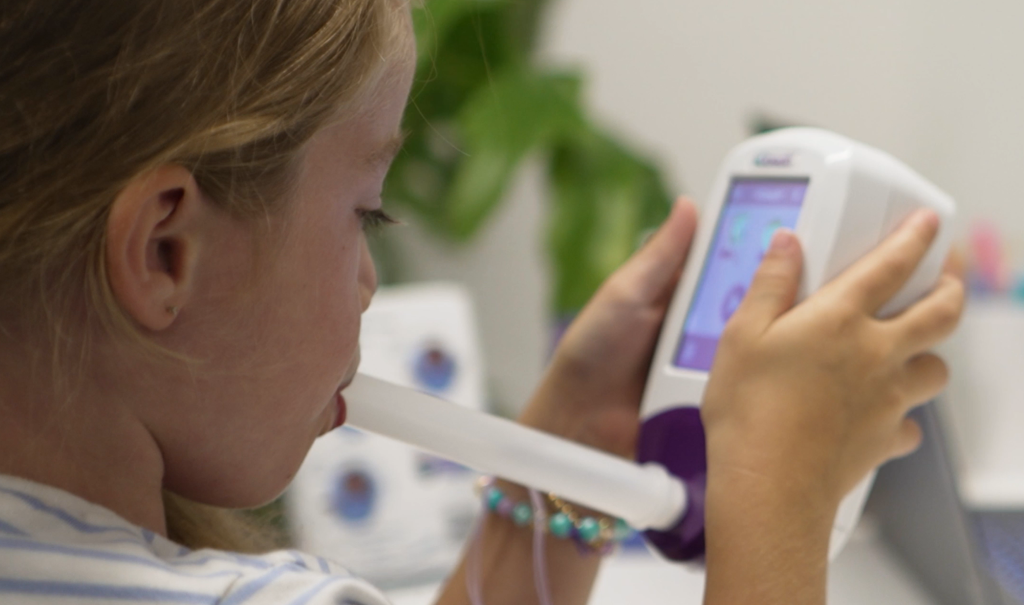
Insufficient FeNO testing leaves children at risk of asthma attacks
Practice Nurse 2026;56(5): online only
Children in half of England could be missing out on an asthma diagnosis, leaving them at increased risk of serious asthma attacks and emergency hospital admissions, according to Asthma + Lung UK.
Research published this week (16 September) reveals that the majority of Integrated Care Systems (ICSs) in England are failing to commission sufficient FeNO testing in primary care for children and young people in their areas.
The charity is calling for equal access to testing across all ICSs, to ensure all children with asthma, no matter where they live, get a fast, accurate diagnosis and access to the treatment they need.
Of the ICSs that responded to Asthma + Lung UK’s survey or Freedom of Information request, over half (59%) did not commission the recommended first line test for childhood asthma to sufficiently cover their area.
Asthma affects nearly 10% of children, and claims a child’s life every 4 weeks. Children in the most deprived communities are four times more likely to die of asthma than those from the least deprived.
Asthma + Lung UK research also points to significant geographic differences in the proportion of children being admitted to hospital in an asthma emergency, with a strong link between deprivation and higher admissions. The charity’s analysis shows that the rate of children’s emergency asthma admissions in the ICS with the highest concentration of deprivation is nearly double that of the ICS with the lowest concentration of deprivation.
The Asthma + Lung UK Respiratory Review also found:
- Only five out of the 26 ICSs who answered a question about FeNO test numbers were able to tell us how many had been performed in their area for children in the last financial year. Ten held only partial data, 11 said data was not available, and 16 ICSs did not respond to the question.
- Just 15 ICSs who responded to the survey reported they were commissioning the recommended testing in primary care for children and young people. Only seven of the 15 services were confident they had the capacity to manage both new diagnostic referrals and existing testing backlogs. For the remaining eight ICSs who are commissioning testing, two stated they did not have sufficient capacity for new referrals, two ICSs said they had capacity for new referrals only, but not any backlog. Two ICSs responded to say that data to assess capacity was unavailable. Two ICSs did not respond to the question about capacity.
With ICSs facing tough financial choices, the charity suggests a lack of national emphasis on respiratory disease means that ICSs are not prioritising children’s asthma care. In response, the charity is calling for a national plan, known as a Modern Service Framework (MSF) that specifically focuses on respiratory care. Such a plan could set minimum expectations for diagnosis and mean that all ICSs in England would be expected to prioritise children’s asthma diagnosis and care.
Dr Matt Swallow, Clinical Lead at Asthma + Lung UK and a practising GP, said: ‘A child’s access to timely and accurate asthma diagnosis should not depend on where they live. Too many children already face avoidable disadvantages to their lung health, from poor-quality housing to high levels of air pollution. These are often factors beyond their families’ control. The fact that some children must also contend with long waits or limited access to diagnostic testing simply because of their postcode is unacceptable.
‘In primary care, we do all we can to keep children with asthma safe and out of hospital; but without the tools to provide an accurate diagnosis, we are already on the backfoot. Without sufficient diagnostic capacity, many children risk being missed altogether, leaving them vulnerable to serious asthma attacks and avoidable emergency hospital visits.’
Key messages
- New research shows more than half of ICSs in England don’t have enough capacity to accurately test children for asthma, failing to meet national asthma guidelines
- Asthma admissions for children living in the areas with the highest concentration of deprivation are nearly twice as high as those in the areas with the lowest concentration of deprivation.
- Asthma + Lung UK is calling for urgent, system-wide improvements to children’s respiratory care
Asthma + Lung UK. Respiratory review 2025-26: children and young people; September 2026. https://www.asthmaandlung.org.uk/respiratory-review-202526-children-young-people
Related news
View all News