Scabies – Guideline in a nutshell
Mandy Galloway, Editor
Practice Nurse 2026;56(5): online only
Scabies cases have risen sharply over recent years according to reports from general practice and sexual health clinics, while care homes and schools in England and Wales have reported more than 200 outbreaks in just one year.
The British Association of Dermatologists has issued expert consensus guidance on the management of scabies in the UK in the light of increasing reports of patients presenting to primary care, dermatology and sexual health departments with scabies, many of whom have difficult to treat infestations.
What is scabies?
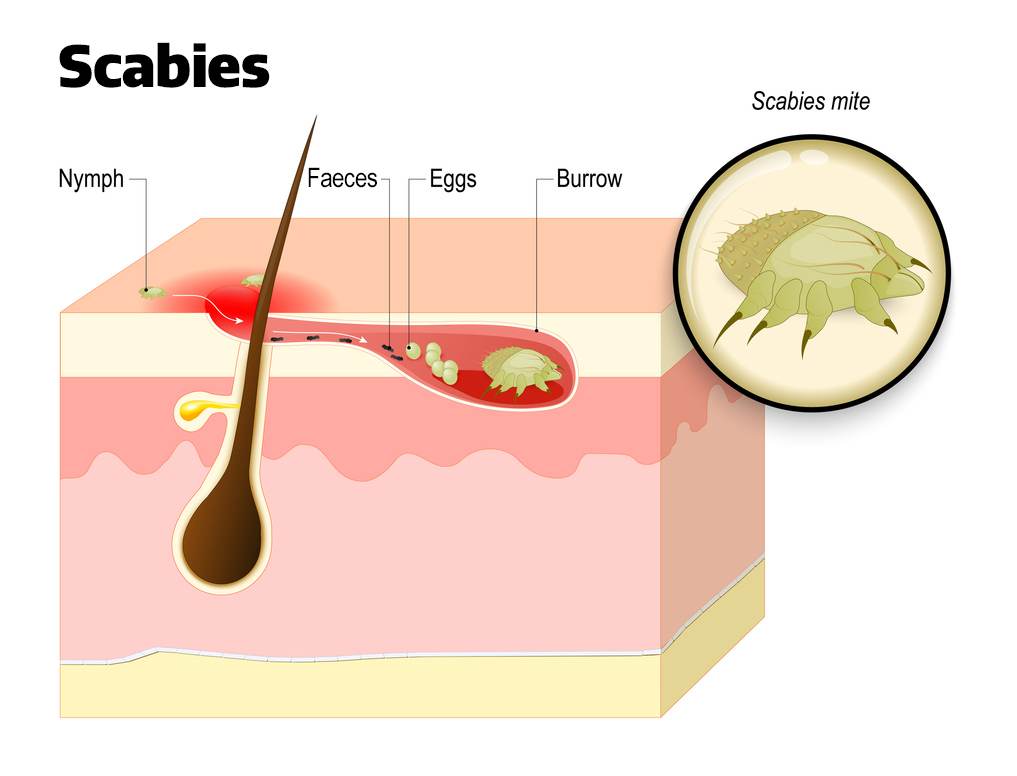
Scabies (Sarcoptes scabie) is a mite infestation which causes an itchy rash, and is readily passed through close, person-to-person contact. Timely treatment of everyone affected and any possible contacts is essential to manage symptoms, prevent complications and control transmission.
The diagnosis of scabies is made by the presence of a rash, typically small erythematous spots on hands and genitals, evidence of S-shaped burrows on the skin, visible mites or eggs, or mite parts, on dermoscopy or microscopic examination of skin scrapings. Confirmation of the diagnosis is particularly important when crusting masks the typical rash.
Scabies infestation be very distressing to patients, especially as it is still associated with significant stigma. It is not, contrary to popular belief, caused by poor personal hygiene: bathing habits make no difference to rates of infestation, and unlike many bacteria and viruses, mites are completely tolerant of soap and alcohol handwashes.
Management
Scabies is best managed in primary care. Waiting for dermatology review can lead to delays in treatment but should be considered if there is uncertainty over the diagnosis or other concerns.
Treatments include topical preparations and oral ivermectin, a broad spectrum anti-parasitic medication. Effective topical options include permethrin 5% cream, malathion 0.5% liquid and benzoyl benzoate emulsion. They may be prescribed or purchased from a pharmacy.
Topical treatment
It is important to provide information on correct application of topical (and treatment of close contacts) to ensure treatment is effective.
- Mites may be present anywhere on the skin, so treatment must be applied all over the body and not just to itchy areas.
- Treatment is best applied at night:
- Remove all clothes
- Wash before applying treatment, paying attention to skin creases and under the nails (which should be cut short)
- Apply to all areas of the skin, including the body, neck, scalp and face, avoiding only the areas around the eyes
- Ensure generous application to skin between fingers and toes, behind the ears, genitalia (including under the foreskin), nipples and under finger and toenails.
- Apply the treatment to the soles of the feet last
- If hands are washed during application of treatment, treatment should be re-applied.
- Leave treatment to dry for 10-15 minutes before dressing
- Leave the treatment on the skin for at least 12 hours
- Re-apply treatment after 12 hours and leave for a further 12 hours.
After 24 hours, wash the product off using only water initially, then use soap and/or emollients.
Treatment does not kill scabies eggs, so should be repeated after 7 days to ensure hatching mites are eliminated.
It is not possible to give precise recommendations for the dose of permethrin, but for most adults and children over 12 years, one whole tube will usually be required. Some adults may need to use an additional tube for full body coverage, but no more than two tubes (60 g) should be used for each application.
Oral treatment
Oral ivermectin should be considered if topical treatment has not resolved symptoms, or there is still evidence of ongoing infestation. Oral ivermectin may also be more appropriate in circumstances where topical treatment may be difficult to apply effectively, for example, in care homes where large numbers of people require treatment.
The dose of ivermectin is based on the patient’s weight, at 200 mcg/kg. It should not be prescribed for children who weigh less than 15 kgs. Ivermectin is available in 3mg tablets, so multiple tablets are likely to be required. The tablets should be taken as a single dose, on an empty stomach. There are a number of known drug-drug interactions, cautions and contraindications, so consult the SmPC before prescribing.
Ivermectin does not kill eggs, so a second dose should be taken 7 days later.
Treating children
Permethrin 5% cream is recommended as first line treatment for children aged 2 months and over.
- Infants or children should be bathed or showered before application
- Nails should be cut short
- Treatment should be applied to all areas of the skin, paying particular attention to skin folds, including nappy area, palms of hands and soles of feet
- Apply generously between fingers and toes
- Apply to external genitalia and buttocks, and to armpits.
It should be applied at night-time and left to dry for 15 minutes before putting on night clothes. Consider mittens for small children who may put their hands in their mouth to avoid ingesting topical treatments. Leave the treatment on for a minimum of 12 hours before washing off the next day. Repeat the treatment after 7 days.
Recommended doses of permethrin for children per application:
- Over 12 years, one tube (30 g)
- Aged 6–12 years, up to half a tube (15 g)
- Aged 15 years, up to a quarter of a tube (7.5 g)
- Children aged 2 months–1 year, up to an eighth of a tube (3.75 g).
All household contacts should be treated at the same time.
Treating contacts
Scabies spreads easily through skin-to-skin contact with other people. Contacts will likely include:
- All household members
- Sexual partners
- Visiting family members, child minders, adult care providers
- Other people who have skin contact with affected individuals
Not everyone with scabies has itch and rash, and asymptomatic people will re-infect their contacts if they are not treated at the same time. People are likely to feel shame or guilt, which can affect willingness to get treatment. Provide reassurance that anyone can get scabies, to ensure everyone receives effective treatment to stop the spread.
Pregnancy
There are no specific studies on the use of topical agents who are pregnant or breastfeeding, or for babies. However, both permethrin and malathion are used to treat scabies in pregnancy and are not known to have adverse effects. Topical treatments are not expected to harm the unborn baby. The manufacturer of ivermectin advises that it should be avoided in pregnant women. Ivermectin should only be given to breastfeeding mothers if the benefit outweighs the potential risk to the infant.
Skin irritation and inflammation
Skin irritation and eczema are commonly seen with scabies, sometimes making diagnosis more difficult. During active infection, scratching can cause secondary dermatitis. All topical preparations used to treat scabies are likely to cause skin irritation leading to eczema or dermatitis, especially if used repeatedly. This can result in ongoing skin problems even when the scabies infection has been successfully eliminated. Itch may be persistent, and areas of dermatitis or inflammatory nodules may also occur.
Skin discomfort – such as burning, stinging or tingling can occur soon after application of permethrin cream, particularly in people with severe scabies, but is usually mild and short-lived. Other signs and symptoms of irritation include erythema, oedema, eczema, rash, and pruritus.
People with dry skin or pre-existing eczema are likely to be particularly affected, but secondary eczema may occur in anyone. Management with emollients may be sufficient, but topical corticosteroids can be prescribed to reduce inflammation and itch.
Source
British Association of Dermatologists. Management of scabies in the UK: expert consensus guidance; September 2026
https://www.bad.org.uk/guidelines-and-standards
Further resources
NICE CKS. Scabies, last revised September 2025; https://cks.nice.org.uk/topics/scabies/
Gavi. Scabies outbreak in UK and Europe; January 2026. https://www.gavi.org/vaccineswork/scabies-outbreak-uk-and-europe-what-you-need-know
Related guidelines
View all Guidelines