
The SIMPLE approach to GLP-1 RA therapies across the CVKM spectrum
Beverley Bostock RGN MSc MA QN ANP in long-term conditions, Mann Cottage Surgery President, Primary Care Cardiovascular Society
Practice Nurse 2026;56(5):12-16
The rapidly expanding range of indications for GLP-1 RAs is great news for patients but can be confusing for healthcare professionals. Here is a simple guide to how and when to use these agents
Since the launch of this drug class, evidence for glucagon-like peptide-1 receptor agonists (GLP-1 RAs) has grown steadily, with indications now spanning a range of cardiovascular-renal-metabolic (CVKM) conditions.1 This expansion has created opportunities to treat more patients, while also increasing complexity around brands, licences, doses, indications, prescribing routes and commissioning arrangements across the CVKM and obesity spectrum.
This article summarises the current evidence and recommendations for GLP-1 RAs and the dual GLP-1 plus glucose-dependent insulinotropic polypeptide (GIP) therapy, tirzepatide, in the United Kingdom across type 2 diabetes (T2D), weight management (WM), cardiovascular disease (CVD), chronic kidney disease (CKD), heart failure and metabolic-dysfunction-associated steatotic hepatitis (MASH). It also considers what the future may hold for this important class of medication. For simplicity, the term ‘GLP-1 RA’ in this article also includes tirzepatide. Trade names are used to reflect the specific licences for each product. Information about licensed indications, doses, side effects, cautions and contraindications for each product can be found at https://www.medicines.org.uk/emc
The evolution of the GLP-1 RAs
GLP-1 RAs mimic the effect of incretin hormones, glucagon-like peptide-1 (GLP-1) and, in the case of tirzepatide, glucose-dependent insulinotropic polypeptide (GIP).These hormones help to regulate post-prandial glucose levels by stimulating the glucose-dependent release of insulin and suppressing the action of glucagon. As well as lowering blood glucose levels, these hormones promote affect appetite and food intake through their action on the satiety centres in the brain and by slowing the transit of food through the gastrointestinal tract.1 These naturally occurring incretin hormones are quickly deactivated by dipeptidyl peptidase-4 (DPP-4), but in the 1990s, scientists studying the habits and physiology of the Gila Monster discovered that its GLP-1-like hormone, exendin-4, was much more stable and long-lasting than human GLP-1 and this paved the way for the development of GLP-1 RA drugs.
The first GLP-1 RA, exenatide, was an injectable medication licensed for T2D and which had to be given subcutaneously twice daily, but soon once daily drugs such as liraglutide became available and eventually, once weekly drugs, including dulaglutide and semaglutide, became the norm. The first oral GLP-1 RA, Rybelsus (semaglutide) was launched in 2019 as a treatment for T2D and another oral semaglutide, Wegovy, has more recently been licensed for weight management. Both are peptide-based drugs which means they need to be taken on an empty stomach with a small amount of water and with nothing more to be taken by mouth for 30 minutes afterwards. Orforglipron, which has just been licenced in the UK, is a non-peptide oral GLP-1 RA, which has no requirement to be taken on an empty stomach. It is licensed for both T2D and WM. Tirzepatide is licensed for T2D and WM and is the first dual agonist, targeting both GLP-1 and GIP. Survodutide, a dual GLP-1 and glucagon agonist, is currently being trialled for T2D and WM, and also for MASH and liver fibrosis*.2,3 Retatrutide, which is a triple agonist, targeting GLP-1, GIP and glucagon receptors, is not yet licensed in the UK but is showing evidence of benefit in both T2D and WM.4 Further developments in this field of pharmacology are anticipated.
Impact of GLP-1 RAs
GLP-1 RAs have been shown to improve glycaemic control, blood pressure, lipid profiles and inflammation.5 They also support weight loss, which can lead to further improvements in cardiovascular risk factors including fatty liver disease, obstructive sleep apnoea, physical activity levels and quality of life.6,7 There is evidence of benefit in people with established cardiovascular disease (eCVD), whether or not they have a history of T2D.8 Semaglutide now has a licence for use in eCVD at a dose of up to 1mg in people with coexisting T2D and up to 2.4mg in those without.9 Tirzepatide also has evidence of CV benefits but has not yet been licensed to use for CV protection.10 In view of the benefits of these drugs in reducing CV risk, it is essential that clinicians and patients understand that, like SGLT2 inhibitors, these are key players in CVKM protection with their role extending beyond the management of HbA1c and weight.It is equally important that clinicians are aware of the licences and indications for the different GLP-1 RAs, and where NICE positions each product: these do not always overlap, meaning that clinicians will need to consider all of these elements when recommending or prescribing these drugs.
Positioning of GLP-1 RAs in guidelines
The most commonly prescribed GLP-1 RA-based drugs are semaglutide and tirzepatide, although liraglutide may be prescribed for T2D and WM and orforglipron is newly available for both conditions. It can feel confusing when it comes to prescribing a GLP-1 RA when the indications and doses vary. Semaglutide is licensed for T2D and WM but the appropriate drug is based on the brand names: Ozempic for T2D and for secondary prevention of CVD with or without T2D, Wegovy for weight management and Rybelsus for T2D alone. Mounjaro (tirzepatide) is licensed for T2D and WM but not for CVD as yet.
Type 2 diabetes
In T2D, NICE recommends using GLP-1 RAs after establishing the patient on 2g of modified release metformin and an SGLT2 inhibitor (usually dapagliflozin 10mg).11 NICE highlights the value of GLP-1 RAs in people with early-onset T2D (diagnosed before the age of 40) or if they have established CVD.11 Somewhat confusingly, NICE generally only recommends the use of a GLP-1 RA in people living with T2D and obesity if the HbA1c is not at target, whereas the evidence would suggest that this would be a high-priority group for this class of medication to help with weight reduction, irrespective of the HbA1c.6 International guidelines certainly recommend GLP-1 RAs in this group to manage overweight and obesity and reduce future CVKM risk.12 GLP-1 RAs are initiated at a sub-therapeutic dose for a month to allow the patient to recognise and manage any side effects and then uptitrated to the optimal dose for the condition being treated.
Although several GLP-1 RA-based therapies are licensed to treat diabetes, semaglutide (Ozempic or Rybelsus) and tirzepatide (Mounjaro) are the most commonly prescribed for T2D along with dulaglutide (Trulicity). Ozempic injections are initiated at a dose of 0.25mg and can be titrated to 1mg or 2mg as indicated. Rybelsus doses start at 1.5mg, with a maximum dose of 9mg. Mounjaro is initiated at a dose of 2.5mg which is increased to 5mg and then uptitrated to a maximum dose of 15mg.Trulicity is started at a dose of 1.5mg (0.75mg if used as monotherapy) with a maximum dose of 4.5mg.Orforglipron is initiated at a dose of 0.8mg, uptitrating to 17.2mg as required.
Weight management
NICE endorses the use of Mounjaro for WM in primary care in people with a BMI of 35kg/m2 and one or more weight-related comorbidity.13 NICE also supports the use of Wegovy in people with a BMI of 35kg/m2 or more plus a weight-related comorbidity or a BMI 30-34.9kg/m2 with a weight-related comorbidity who meet the criteria for referral to weight management services.11
NICE advises that lower BMI thresholds, usually reduced by 2.5 kg/m², can be used for people from South Asian, Chinese, other Asian, Middle Eastern, Black African or African-Caribbean ethnic backgrounds.11
NICE states that all people using GLP-1 RAs for WM should have access to lifestyle advice and behavioural support to complement their medication. Currently an estimated 95% of GLP-1 RAs prescribed for WM are being prescribed privately, meaning that NHS clinicians need to consider their responsibilities to this group of people. Pharmacological weight loss without support or follow-up risks discontinuation, adverse effects, unrealistic expectations and weight regain.
However, the licence indications for Mounjaro and Wegovy differ from NICE’s recommendations. Both are licensed for use in people with a BMI of 30kg/m2 or 27kg/m2 in the presence of an obesity-related complication such as T2D, hypertension, dyslipidaemia, obstructive sleep apnoea, metabolic dysfunction associated steatotic liver disease (MASLD) or CVD. Wegovy is also licensed to use up to a maximum dose of 7.2mg but is not yet approved by NICE for NHS reimbursement. Orforglipron can be used for WM at the same doses used for T2D in people with a BMI of ≥30 kg/m2 or ≥27 kg/m2 in the presence of at least one weight-related comorbidity e.g. prediabetes or type 2 diabetes mellitus, hypertension, dyslipidaemia, obstructive sleep apnoea, or cardiovascular disease.
Established CVD
In people with T2D and established CVD, Ozempic can be initiated at 0.25mg and uptitrated to a dose of 1mg. In people who do not have T2D but who have established CVD and a BMI of 27kg/m2 or more, Ozempic can be prescribed up to a dose of 2.4mg.
It is interesting to compare NICE guidelines with international recommendations.The American Diabetes Association/European Association for the Study of Diabetes (ADA/EASD) guidance recommends GLP-1 RAs as second- or third-line treatment for people living with T2D and endorses their use to support weight management and to reduce CV risk.12 The ADA/EASD also advises that when deliberating whether to introduce insulin into the management of T2D, a GLP-1 RA should be considered first, as a result of the risk: benefit profile of each treatment option.12
Pre-start checklist – keeping it SIMPLE: suitability, indication, medication, preparation, lifestyle, evaluation
Based on the fact that both national and international guidelines recommend the use of GLP-1 RAs in an increasing number of people, clinicians need to be clear about how and when to recommend and initiate them.The SIMPLE checklist has been designed to help with this process.
S – suitability
The baseline patient assessment prior to initiation of a GLP-1 RA should include weight, BMI and/or waist to height ratio, blood pressure, HbA1c, renal function, drug history, pregnancy and breastfeeding status, cardiovascular history and retinopathy screening in people with T2D.
A check should be made for possible cautions or contraindications. Contraindications would include a current or planned pregnancy, breastfeeding for semaglutide, a previous history of medication-induced pancreatitis or a history of thyroid cancer. Cautions would include the presence of retinopathy, a previous history of non-drug-related pancreatitis or gall bladder disease, and frailty.
GLP-1 RAs should be stopped before trying for a pregnancy – at least 2 months for semaglutide, at least one month for tirzepatide.Barrier methods of contraception may be advised for 4 weeks when tirzepatide is initiated or uptitrated or if vomiting occurs on any GLP-1 RA. A patient leaflet on this can be found here. Hormone replacement therapy doses may also need adjusting when starting on a GLP-1 RA.13
I - indication
Consider the reason for recommending a GLP-1 RA.The indication could be for T2D, WM or CVD risk reduction and the choice of drug and dose will depend on the indication.
M – medication
Different GLP-1 RAs are licensed for different conditions so clinicians should be aware of which drug would be appropriate for that individual. Semaglutide is available as Ozempic injections, Wegovy injections and tablets, and Rybelsus tablets. Table 1 summarises the current situation with each product in terms of the licence, administration route and dose. Orforglipron has recently been licensed for use in T2D and WM. NICE has stated that there is no need for a specific technology appraisal for its use and it can be used wherever a GLP-1 based medication is currently recommended by them for T2D or WM. Orforglipron has been shown to lead to better A1c results and greater weight loss than oral semaglutide but was also shown to have a higher discontinuation rate, due to GI side effects.14
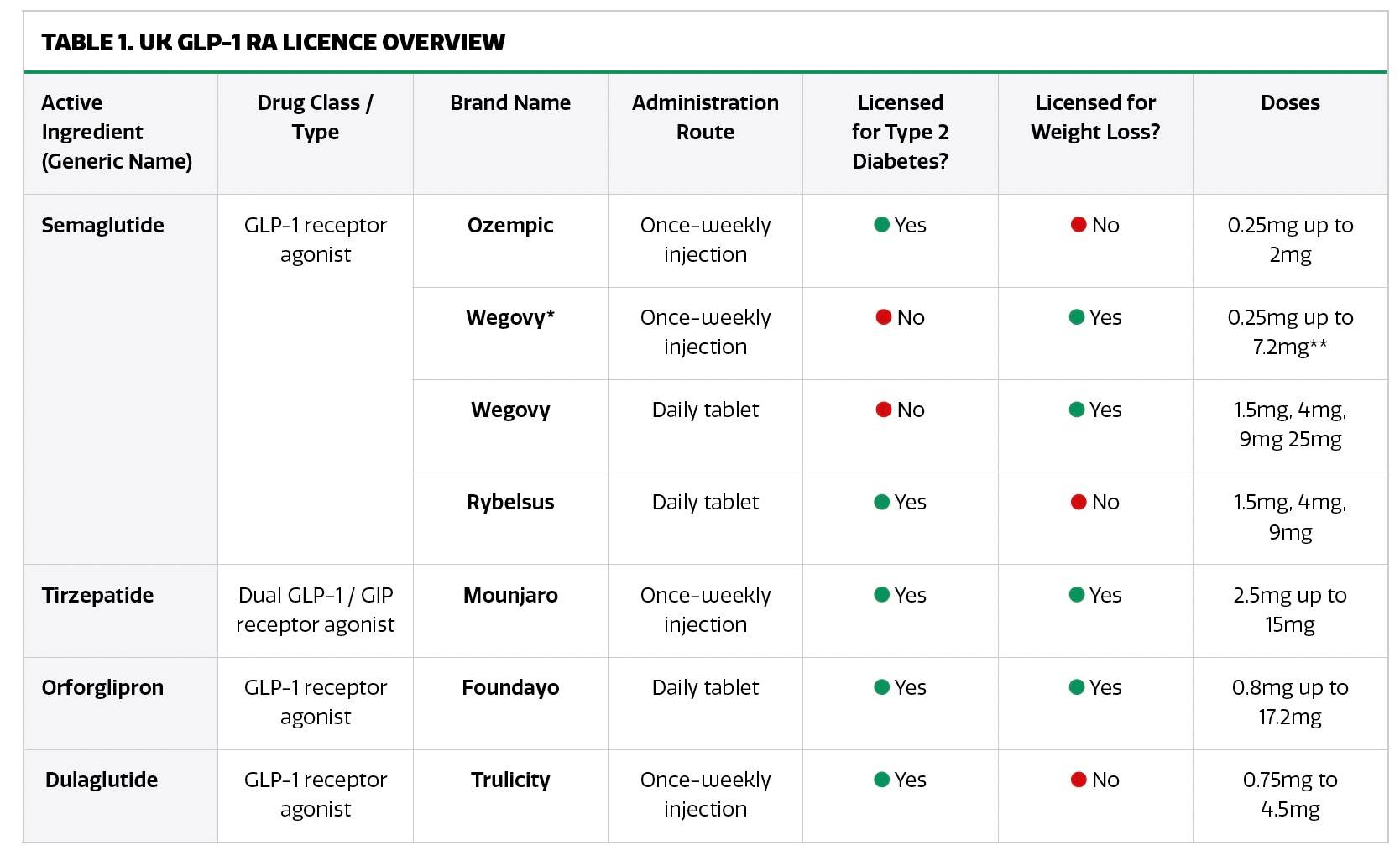
*Wegovy is also licensed for established CVD in people with a BMI of 27kg/m2 up to a dose of 2.4mg. **Wegovy 7.2mg is licensed but is not currently reimbursed for NHS use
P – preparation
As people will be self-administering any injectable medication, they will need to be taught injection technique, sharps safety and infection control. The companies that make semaglutide and tirzepatide have online resources that can be accessed at https://www.ozempic.co.uk/patientresources.html, https://uk.lilly.com/metabolic/hcp/diabetes/mounjaro/resources, and https://www.wegovy.co.uk. For oral semaglutide, people need to know that it must be taken on an empty stomach, with a small amount of water and with nothing else taken by mouth for the next 30 minutes. Orforglipron does not have these restrictions so may be an easier option for some. However, because it is relatively new to the market, Integrated Care Boards (ICBs) may not have it on their formularies yet.
People will need to understand how to manage possible side effects which are predominantly gastrointestinal in nature: diarrhoea, constipation, nausea, vomiting or dyspepsia. The risk of GI side effects can be reduced by eating slowly and stopping before feeling full, avoiding spicy or greasy foods and limiting or avoiding alcohol. The judicious use of anti-diarrhoeal medication or laxatives and anti-nausea treatments (including ginger, anti-emetics or pressure bands, such as those used to manage pregnancy sickness) may be needed to treat these symptoms although they usually resolve over time.
Rare side effects include acute pancreatitis, which presents as severe, persistent abdominal pain that may radiate to the back and may be accompanied by nausea and vomiting. Patients should be warned about this and advised to seek medical help immediately if these symptoms occur. In January 2026, the MHRA strengthened warnings about acute pancreatitis for both GLP-1 RAs and dual GLP-1/GIP agonists.16 Patients must discontinue treatment if pancreatitis is suspected, and should not restart if the diagnosis is confirmed.
It is also important to advise patients to stop any DPP4 inhibitors (-gliptins) when starting a GLP-1 RA as there is an overlap in their mode of action, making the DPP4i redundant.
L – lifestyle
People who are starting on GLP-1 RAs should be made aware that the drugs do not work in isolation and must be combined with lifestyle interventions such as healthy eating habits and physical activity. A protein-rich, balanced diet is essential for optimising holistic wellbeing, and reducing the risk of nutritional deficiencies, which can result in loss of muscle mass and sarcopenia.17 Advice on staying hydrated is also important, as GLP-1 RAs can reduce the perception of thirst as well as hunger. People may find that they are unable to drink with a meal as it makes them feel too full so it may be preferable to drink at least 30 minutes before or after food. Physical activity should be encouraged, and weight loss may enable people to engage in this more easily.
E – evaluation
Follow-up appointments are essential as this is an opportunity to assess tolerability, titrate doses, check adherence, review injection technique, nutrition, physical activity and mental wellbeing, ask about adverse effects, and measure response through BMI and HbA1c where appropriate.In people taking GLP-1 RAs for established CVD, the aim is to provide cardioprotection, not necessarily to see weight or HbA1c reductions, although this will depend on the patient. As a rule, people with established CVD should remain on the drug for CV protection.9 In T2D, NICE recommends continuing GLP-1 RAs even if targets have been achieved as the CVKM benefits will continue.11 In WM, the pros and cons of stopping treatment should be discussed in advance, as evidence suggests that weight regain is often seen on discontinuing GLP-1 RAs.17 The only reasons to stop a GLP-1 RA are patient preference, inability to tolerate, development of contraindications, or BMI falling to below 18.5kg/m2.11
People living with multimorbidity
The fact that recommendations for GLP-1 RA drugs and doses change depending on the indication for use may appear problematic if the person has multiple risk factors. For example, should a higher dose of semaglutide be prescribed for someone with established CVD who is also living with obesity? In these situations, a shared decision-making approach should be used, focussing on the licensed indications and the condition that is most important clinically. There are many patients living with T2D who have achieved excellent results with respect to glycaemic control, but who want to improve weight loss by increasing the dose of their GLP-1 RA. If following the NICE T2D guidelines precisely, the clinician will not be able to increase the dose, although they may decide to focus on the licence, or the WM guidance, in this situation.
Other possible indications for GLP-1 RA use
Specialists may also recommend GLP-1 RAs for CKD, heart failure with preserved ejection fraction (HFpEF) or MASH based on the evidence for their use in these conditions.
Chronic kidney disease
In the FLOW trial, the use of once-weekly subcutaneous semaglutide (1.0 mg) was assessed versus placebo in 3,533 patients with type 2 diabetes and chronic kidney disease. The results showed a 24% reduction in major kidney events and kidney failure and a 20% reduction in all-cause mortality.Major adverse cardiovascular events (MACE) were reduced by 18%.19
Metabolic liver disease
Based on trial evidence, Wegovy injection is licensed for the treatment of non-cirrhotic metabolic dysfunction-associated steatohepatitis (MASH) in adults with moderate to advanced liver fibrosis, although NICE approval is still awaited.20,21
Heart failure with reduced ejection fraction
Both semaglutide and tirzepatide have shown positive outcomes for people living with HFpEF, significantly reducing the combined risk of heart failure hospitalisation and all-cause mortality.22,23
Although NICE may not currently endorse the use of these drugs in CKD or HFpEF, there is evidence of benefit so clinicians should be aware of the evidence in anticipation of possible licence changes in the future.
Conclusion
Sitting at the intersection of T2D, obesity, and cardiorenal risk reduction, GLP-1 RA-based therapies have transformed the management of these conditions. Clinicians need to be aware of the increasing use of these medications, including through private providers, in order to support their safe use. Both the drugs and the evidence continue to evolve.Orforglipron is the latest GLP-1 RA to receive a licence for T2D and WM alongside established molecules such as semaglutide, tirzepatide and dulaglutide.Retatrutide, a triple agonist receptor, is likely to be the next addition to the increasing armoury of drugs used to improve CVKM conditions but has not yet been licensed for use.However, like all drugs, they have effects and side effects so they should only be used in appropriate populations, with clear advice and safety netting. Used well, they can improve outcomes across multiple conditions, but the challenge is to prescribe them within safe, evidence-based, person-centred parameters that combine pharmacology with behavioural support, monitoring and long-term risk management.
References
- Darwish R, Abu-Sharia G, Butler AE. (2025). History of glucagon-like peptide-1 receptor agonists. Pharmacol Res 2025;222:108045. https://doi.org/10.1016/j.phrs.2025.108045
- le Roux CW, Wharton S, Startseva E, et al, & SYNCHRONIZE-1 Investigators. Survodutide Once Weekly for the Treatment of Adults with Obesity. N Engl J Med 2026;395(8):776–787. https://doi.org/10.1056/NEJMoa2600751
- Kaplan LM, Startseva E, le Roux CW, et al, & SYNCHRONIZE-MASLD Investigators (2026). Survodutide in adults with obesity and metabolic dysfunction-associated steatotic liver disease: SYNCHRONIZE-MASLD, a randomized, double-blind, placebo-controlled phase 3 trial. Nature medicine, 32(8), 2948–2958. https://doi.org/10.1038/s41591-026-04479-3
- Katsi V, Koutsopoulos G, Fragoulis C, et al.(2025). Retatrutide - A Game Changer in Obesity Pharmacotherapy. Biomolecules 2025;15(6):796. https://doi.org/10.3390/biom15060796
- Collins L, Costello RA. Glucagon-Like Peptide-1 Receptor Agonists. In: StatPearls Treasure Island (FL): StatPearls Publishing; 2024 https://www.ncbi.nlm.nih.gov/books/NBK551568/
- Ahmad N, Alruwayyes A, Alarjani A, et al. GLP-1 receptor agonists for weight loss: A systematic review and meta-analysis of randomized controlled trials. Medicine 2026;105(11): e47994. https://doi.org/10.1097/MD.0000000000047994
- Dandamudi M, Lucena L, Gamarra-Valverde NN, et al. Efficacy of GLP-1 Receptor agonists in treating obstructive sleep apnoea: A systematic review and meta-analysis of cardiometabolic and respiratory outcomes. Schlaf & Atmung (Sleep & Breathing) 2026;30(2): 138. https://doi.org/10.1007/s11325-026-03681-4
- Yang HM. GLP-1 Agonists in Cardiovascular Diseases: Mechanisms, Clinical Evidence, and Emerging Therapies. J Clin Med 2025;14(19):6758. https://doi.org/10.3390/jcm14196758
- NICE TA1152. Semaglutide for reducing the risk of major adverse cardiovascular events in people with cardiovascular disease and overweight or obesity; 2026 https://www.nice.org.uk/guidance/ta1152
- Ostrominski JW, Ortega-Montiel J, Wexler D J, et al.Comparative Effectiveness of Tirzepatide Versus Dulaglutide or Semaglutide on Major Cardiovascular Events in Type 2 Diabetes and Cardiovascular Disease: Insights From Two Target-Trial Emulations. Diabetes Care 2026; 49(5):808–817. https://doi.org/10.2337/dc25-3063
- NICE NG28. Type 2 diabetes in adults: management; 2026 https://www.nice.org.uk/guidance/ng28
- Davies MJ, Aroda VR, Collins BS, et al. Management of Hyperglycemia in Type 2 Diabetes, 2022. A Consensus Report by the American Diabetes Association (ADA) and the European Association for the Study of Diabetes (EASD). Diabetes Care 2022;45(11):2753–2786. https://doi.org/10.2337/dci22-0034
- NICE NG246. Overweight and obesity management; 2026. https://www.nice.org.uk/guidance/ng246
- British Menopause Society. Use of incretin-based therapies in women using hormone replacement therapy (HRT); 2025 https://thebms.org.uk/wp-content/uploads/2025/05/23-BMS-TfC-Use-of-incretin-based-therapies-APRIL2025-E.pdf
- Pandey RK, Jan M, Mohammad A, et al. Efficacy and Safety of Orforglipron in Obese Adults With or Without Diabetes: A Systematic Review and Meta-Analysis. Endocrinol DiabetesMetab2025;8(6):e70134. https://doi.org/10.1002/edm2.70134
- MHRA. GLP-1 receptor agonists and dual GLP-1/GIP receptor agonists: strengthened warnings on acute pancreatitis, including necrotising and fatal cases; 2026 https://www.gov.uk/drug-safety-update/glp-1-receptor-agonists-and-dual-glp-1-slash-gip-receptor-agonists-strengthened-warnings-on-acute-pancreatitis-including-necrotising-and-fatal-cases
- Neeland I J, Linge J, Birkenfeld AL. Changes in lean body mass with glucagon-like peptide-1-based therapies and mitigation strategies. Diabetes Obes Metab 2024;26(Suppl 4):16–27. https://doi.org/10.1111/dom.15728
- Reiss AB, Gulkarov S, Lau R, et al. (2025). Weight Reduction with GLP-1 Agonists and Paths for Discontinuation While Maintaining Weight Loss. Biomolecules 2025;15(3):408. https://doi.org/10.3390/biom15030408
- Perkovic V, Tuttle KR, Rossing P, et al, & FLOW Trial Committees and Investigators (2024). Effects of Semaglutide on Chronic Kidney Disease in Patients with Type 2 Diabetes. N Engl J Med 2024;391(2):109–121. https://doi.org/10.1056/NEJMoa2403347
- Singh A, Sohal A, Batta A. (2024). GLP-1, GIP/GLP-1, and GCGR/GLP-1 receptor agonists: Novel therapeutic agents for metabolic dysfunction-associated steatohepatitis. World J Gastroenterol 2024;30(48), 5205–5211. https://doi.org/10.3748/wjg.v30.i48.5205
- MHRA.Semaglutide (Wegovy) approved to treat form of liver disease; 2026 https://www.gov.uk/government/news/semaglutide-wegovy-approved-to-treat-form-of-liver-disease
- Arty F, Shreya D, Chaudhry A, Sohini S. Semaglutide in heart failure with preserved ejection fraction: emerging evidence and clinical implications. Cureus 2025;17(7):e87605. https://doi.org/10.7759/cureus.87605
- Packer M, Zile M R, Kramer CM, et al, & SUMMIT Trial Study Group. Tirzepatide for Heart Failure with Preserved Ejection Fraction and Obesity. N Engl J Med 2025;392(5):427–437. https://doi.org/10.1056/NEJMoa2410027
Related articles
View all Articles