
How GPNs can support earlier recognition of ATTR-CM
Angelique Smit, Lead Clinical and Research Nurse, National Amyloidosis Centre (NAC)
Practice Nurse 2026;56(5):8–11

NP-UKI-00224 | August 2026
Angelique Smit, Lead Clinical and Research Nurse at the National Amyloidosis Centre (NAC), discusses why general practice nurses are uniquely placed to recognise transthyretin amyloid cardiomyopathy (ATTR-CM) earlier, and explains how asking a few additional questions could help patients get diagnosed and access treatment sooner.
Q. ATTR-CM is receiving much more attention than it did a few years ago. For nurses who may be unfamiliar with it, what is ATTR-CM and what has changed in recent years?
A. ATTR-CM stands for transthyretin amyloid cardiomyopathy. It occurs when the transthyretin protein misfolds and forms amyloid deposits within the heart muscle. Over time, those deposits make the heart thicker and stiffer, which means it cannot fill and pump as efficiently as it should. The deposits can also affect the heart's electrical system, so patients may develop rhythm disturbances or conduction problems as the disease progresses. There are two forms of the condition: wild-type ATTR, which is generally associated with ageing, and hereditary ATTR, which is caused by an alteration in the transthyretin (TTR) gene.
WHAT IS ATTR-CM? |
|
Q. How common is ATTR-CM?1,2
A. ATTR-CM is considered a rare disease, but experts believe it is significantly underdiagnosed.
- Wild-type ATTR-CM most commonly affects older adults, particularly men aged 70 years and over
- The average age at diagnosis is around 75-80 years
- Diagnoses have increased substantially in the UK over the past decade due to improved awareness and imaging techniques
- ATTR-CM is increasingly recognised among patients with heart failure, aortic stenosis and unexplained thickening of the heart muscle
Q. ATTR-CM is often described as a heart condition, but is it actually part of a wider disease process?
A. Absolutely. ATTR-CM is one manifestation of a broader condition called ATTR amyloidosis, which is a multisystem disease. Amyloidosis occurs when proteins misfold and form amyloid deposits that accumulate in tissues and organs throughout the body. In ATTR amyloidosis, these deposits can affect the heart, peripheral nerves, tendons, ligaments, gastrointestinal system and, less commonly, other organs.
This is why patients may develop symptoms such as carpal tunnel syndrome, spinal stenosis or neuropathy years before cardiac symptoms become apparent. Understanding ATTR-CM as part of a systemic disease helps explain why joining the dots between seemingly unrelated symptoms is so important.1
Q. What is one of the biggest changes you have seen in ATTR-CM in your experience?
A. One of the biggest changes in recent years has been the availability of effective treatment. When I started in this role eight years ago, there were simply no treatments available for patients with ATTR-CM. Looking back, it was probably one of the most difficult clinics to work in because while patients might finally receive a diagnosis, there was very little we could offer them beyond supportive care. Today, the situation is completely different. We now have disease-modifying treatments available, more therapies are being developed, and the outlook for patients has improved significantly.
That shift is one of the reasons awareness has become so important. The treatments we have now can slow disease progression, but they cannot necessarily reverse damage that has already occurred. If patients reach specialist services after years of symptoms and years of amyloid accumulation within the heart, substantial changes may already have occurred that cannot be undone. The earlier we identify people, the greater the opportunity to preserve heart function and improve long-term outcomes.
Since there are now effective treatments, recognising the early signs of amyloidosis matters far more than it used to. Many healthcare professionals still view ATTR-CM as something they are unlikely to encounter. Certainly, when I started working in amyloidosis, awareness was much lower than it is today, but we now understand the condition better than we used to and are therefore able to diagnose more patients.
Q. Why should ATTR-CM now be particularly relevant to GPNs?
A. I think practice nurses can play a much bigger role than they sometimes realise.
GPNs often have more time to spend with patients than other healthcare professionals, and that can make a significant difference for people living with a condition like ATTR-CM. This is not usually a disease that announces itself through one obvious symptom. Instead, it tends to appear through a series of small clues that may be spread across different body systems and several years of a patient's life.
From my experience, patients often tell nurses things they do not necessarily tell doctors. For example, a patient may come in for a chronic disease review and mention that they can no longer walk into town, do their shopping or manage the activities they used to do. They might mention they've had carpal tunnel surgery in the past, or that they've developed numbness in their feet. Individually, those details may not seem particularly important. However, when they are considered together, they can start to paint a very different picture.
I always say nurses are ideally placed to join the dots. ATTR-CM is a condition where patterns matter. Patients frequently move between different specialties before diagnosis. They might have seen orthopaedics for spinal problems, neurology for neuropathy, gastroenterology for bowel symptoms and cardiology for heart failure. Unless someone steps back and looks at the whole patient rather than one individual symptom, the diagnosis can be missed.
GPNs often see those patients repeatedly over time. They build relationships, notice changes and patients tend to trust them. That position of trust is incredibly valuable. If a patient feels comfortable talking to you, they are more likely to share information about symptoms, functional limitations and changes in their daily life that they may not mention elsewhere. Sometimes the clue that eventually leads to a diagnosis emerges from exactly those conversations.
I think it's important for nurses to feel empowered in this space. GPNs play a fundamental role in recognising patterns, raising concerns and documenting important information, all of which can have a significant impact on a patient's journey.
Q. What are the red flags, signs and symptoms that GPNs should be most aware of?
A. One of the biggest challenges with ATTR-CM is that many of the symptoms are common and frequently seen in primary care. Practice nurses should be alert to patients presenting with:1
- Breathlessness
- Fatigue
- Reduced exercise tolerance
- Swollen ankles (ankle oedema)
- Abdominal swelling or recurrent fluid retention
- Palpitations
- Atrial fibrillation
- Dizziness
- Near-syncope or episodes of fainting
I would encourage nurses to think about whether the overall picture makes sense. Is somebody becoming progressively limited by fatigue? Have they developed heart failure despite a normal or only mildly reduced ejection fraction? Have they gone from needing treatment for high blood pressure to developing unexpectedly low blood pressure? Has a patient required a pacemaker or developed conduction disease without an obvious explanation? Sometimes it's that feeling that something does not quite fit together that should prompt a closer look.
However, the clues that are most often missed are frequently outside the heart.
The one we talk about most is carpal tunnel syndrome. We hear it repeatedly in clinic. Patients often arrive and casually mention that they had carpal tunnel surgery years earlier. They don't think it's relevant, and often nobody has ever suggested that it might be connected to a heart condition. Yet it is one of the most common red flags we see.
The Carpal Tunnel Connection3
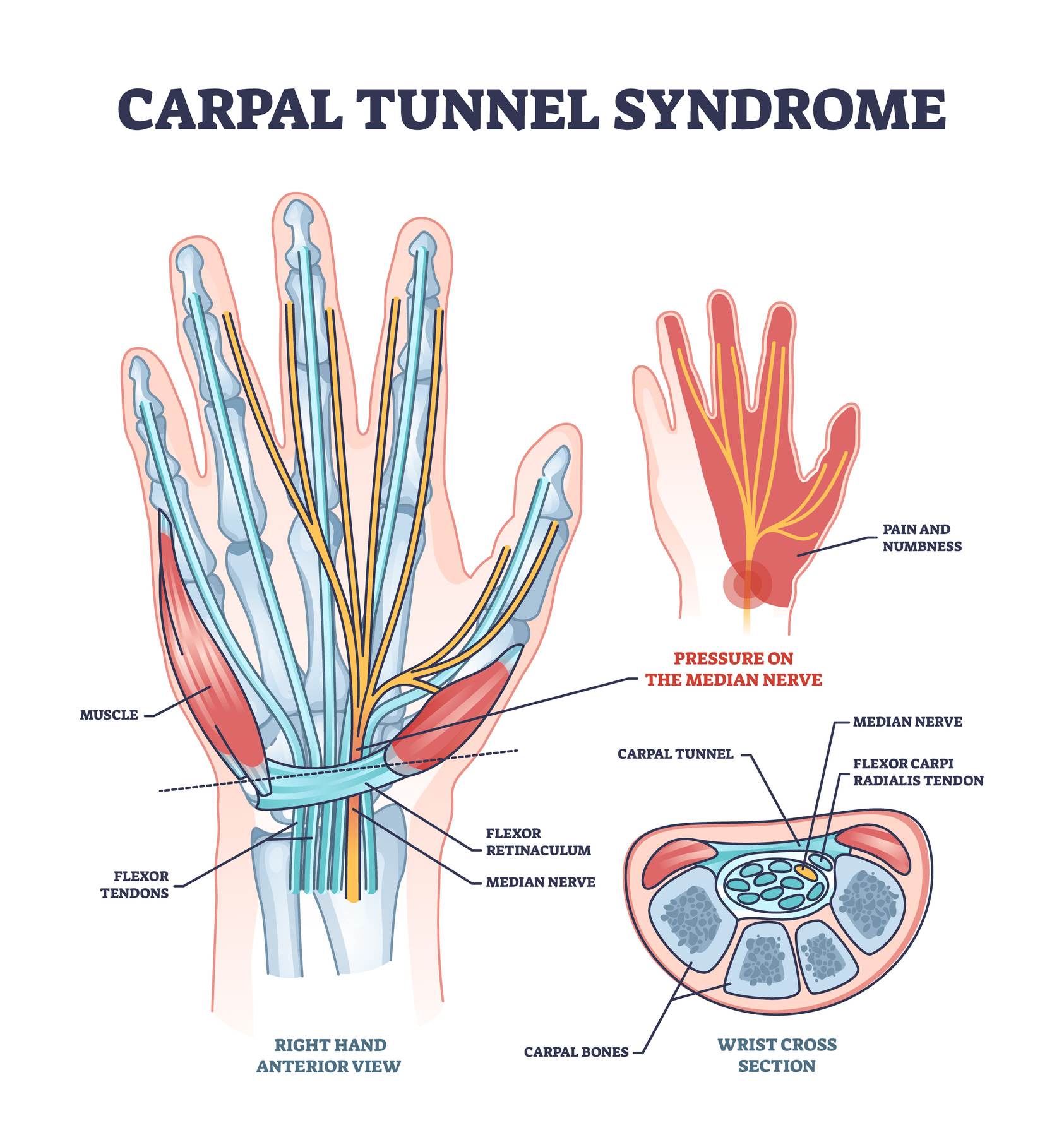
Amyloid deposits can build up in the tendons and soft tissues of the wrist, compressing the median nerve and causing carpal tunnel syndrome.
- Bilateral carpal tunnel syndrome may precede the diagnosis of ATTR-CM by several years, often 5-10 years before cardiac symptoms become apparent.
- It may be one of the earliest signs of systemic amyloid deposition
Other important clues include lumbar spinal stenosis, previous spinal surgery and spontaneous biceps tendon rupture. Peripheral neuropathy is another key feature. Patients may describe numbness, tingling, pain or altered sensation in their hands and feet. We also see autonomic symptoms such as postural dizziness, altered bowel function and erectile dysfunction. These symptoms may be present for years before any cardiac diagnosis is considered.1
Family history is another area I think nurses should explore. Asking about cardiomyopathy, neuropathy, heart failure, pacemakers and unexplained cardiac deaths can provide important information, particularly where hereditary ATTR may be involved. Importantly, though, the absence of a family history does not rule the condition out.
The key message is that no single red flag confirms ATTR-CM. It's usually the combination of symptoms, along with the sequence in which they have appeared, that raises suspicion. The more you understand the condition as a multisystem disease, the easier it becomes to recognise those patterns.
Q. Why are patients still being diagnosed late?
A. Many of the patients who eventually reach us have already seen five or six clinicians before ATTR-CM is considered. That isn't because people are missing obvious signs. In reality, the symptoms overlap with many common conditions, including ordinary heart failure, hypertension, atrial fibrillation and aortic stenosis. ATTR-CM can sit beneath those diagnoses for years before somebody recognises what is really going on.
Another challenge is that the signs of ATTR-CM often appear at different stages of a patient's healthcare journey. A patient may first be seen for carpal tunnel syndrome, then years later develop spinal stenosis, and only afterwards present with cardiac symptoms. If different symptoms are viewed in isolation, it becomes very difficult to identify the underlying pattern.
There are also a number of misconceptions that continue to contribute to delays. One of the most common is the belief that ATTR-CM is so rare that it is not worth considering. Closely linked to that is the idea that there is no treatment available. Those assumptions may have been understandable in the past, but they are no longer true. Patients can now benefit from effective treatment options which makes timely diagnosis increasingly important.
We also see misconceptions around who is affected. ATTR-CM is often viewed as a disease of older white men, but women can absolutely be affected as well, and we believe they may be under-recognised. Similarly, people of African ancestry may carry hereditary TTR variants, but symptoms may be attributed to more common causes such as hypertension or conventional heart failure.
Other common myths include the belief that every patient must have a reduced ejection fraction or a low-voltage ECG, that carpal tunnel syndrome and spinal problems have nothing to do with heart disease, or that a patient cannot have hereditary disease if there is no obvious family history. We also still encounter healthcare professionals who believe diagnosis always requires a heart biopsy, when many patients can now be diagnosed using blood and urine tests alongside specialist imaging.
Ultimately, delayed diagnosis often happens because the clues are dismissed individually rather than recognised as part of one multisystem condition. That's why awareness and pattern recognition are so important.
Q. Why does early diagnosis matter?1
A. ATTR-CM is a progressive disease that can lead to worsening heart failure, arrhythmias and premature death if left untreated.
- Historically, treatment was limited to symptom management and supportive care
- Disease-modifying treatments are now available for eligible patients
- Clinical studies show treatment can reduce mortality and cardiovascular hospitalisations
- The earlier treatment is started, the greater the opportunity to preserve heart function and quality of life
Q. If a practice nurse suspects ATTR-CM, what practical steps can they take?
A. The first thing I would say is: take a good look at the patient’s history.
When something doesn't quite make sense, ask a few more questions. Ask about previous carpal tunnel syndrome, spinal problems, neuropathy, family history and symptoms of heart failure. Explore changes in day-to-day function. Can the patient still do the activities they used to do? Have they become more fatigued? Are they noticing symptoms that seem unrelated but have appeared over the same period? Those conversations can be incredibly valuable.
The second thing is documentation. If you identify potential red flags, write them down clearly. Sometimes the information is there, but it has been recorded in different places and nobody has recognised the significance. Good documentation allows the next healthcare professional who sees the patient to understand the full picture.
I would also encourage nurses to feel confident about raising concerns. You do not need to make the diagnosis yourself. The important thing is recognising a possible pattern and bringing it to somebody's attention. If you think there are red flags for cardiac amyloidosis, discuss it with the GP, heart failure team or cardiologist. Nurses often contribute far more to the diagnostic process than they realise.
Where local pathways allow, nurses can support routine investigations such as ECGs, observations and blood tests. If you are documenting a concern, be specific. Rather than simply noting breathlessness, explain why you are concerned. Highlight relevant features such as heart failure symptoms, carpal tunnel syndrome, neuropathy or other amyloidosis red flags. That helps direct attention towards the possibility of a unifying diagnosis.
Urgent symptoms should always be escalated appropriately. Patients experiencing syncope, rapid deterioration or decompensated heart failure require prompt assessment. However, even in less urgent situations, recognising a pattern and speaking up can have a significant impact. Sometimes all it takes is one person asking the right question at the right time.
Q. Finally, what is the one message you would like every practice nurse to remember?
A. Join the dots.
If somebody has heart failure or unexplained thickening of the heart and they also have a history of bilateral carpal tunnel syndrome, neuropathy, spinal problems or some of the other red flags we've discussed, don't dismiss those clues individually.
I think nurses are often much more influential in the diagnostic pathway than they realise. They're the people patients talk to and trust, and often the professionals who have the best understanding of how symptoms have changed over time. ATTR-CM is one of those conditions where recognising a pattern can make all the difference.
The phrase I often use is: ‘The first clue to ATTR-CM may appear in the hands years before it appears in the heart.’ When you think about the number of patients who describe carpal tunnel syndrome years before developing cardiac symptoms, that message really resonates.
Earlier recognition means earlier investigations, earlier diagnosis and earlier access to treatment. Nurses don't need to make the diagnosis themselves, but they can play a crucial role in ensuring that patients get onto the right pathway.
If more nurses understand the red flags, feel confident asking questions and recognise when something doesn't quite fit together, we have a real opportunity to improve outcomes for people living with ATTR-CM.
THINK ATTR-CM IF...1 |
|
Disclaimer: The views and observations expressed in this article reflect Angelique Smit's clinical experience as Lead Clinical and Research Nurse at the National Amyloidosis Centre. The article was developed from an interview with Angelique and supplemented with referenced clinical information for educational purposes. Angelique received no payment for participating in this article. Alnylam UK initiated and supported the development of the article and reviewed the final content for factual accuracy and compliance.
FURTHER INFORMATION
For more information on ATTR-CM, referral pathways and clinical guidance, visit the National Amyloidosis Centre (NAC). Further resources for nurses and other healthcare professionals, patients and families are available from Amyloidosis UK (amyloidosisuk.org) or by emailing info@amyloidosisuk.org.
References
- Tschöpe C, Elsanhoury A, Kristen AV. Transthyretin Amyloid Cardiomyopathy – 2025 Update: Current Diagnostic Approaches and Emerging Therapeutic Options. J Clin Med. 2025;14(13):4785. doi:10.3390/jcm14134785
- Porcari A, Razvi Y, Masi A, et al. Prevalence, Characteristics and Outcomes of Older Patients with Hereditary Versus Wild-Type Transthyretin Amyloid Cardiomyopathy. Eur J Heart Fail. 2023;25(4):515-524. doi:10.1002/ejhf.2776.
- Razvi Y, Gilbertson J, Heras-Palou C, et al, for EDUCATE Study Collaborators. Early Diagnosis of ATTR-CM Using Carpal Tunnel Biopsy Examination: EDUCATE: A United Kingdom Prospective Multicenter Study. JACC Heart Failure. 2026;14(4):102890. doi:10.1016/j.jchf.2025.102890.
Related articles
View all Articles