
Managing uncontrolled and severe asthma
Samantha Prigmore RGN BSc, MSc Independent Consultant Respiratory Nurse. Network Manager, South West Severe Asthma Network, Somerset Foundation Trust
Practice Nurse 2026;56(4):15-19
Asthma can have a significant and negative impact on quality of life for individuals living with it – especially when it is uncontrolled. So how should we identify people with uncontrolled asthma, manage their symptoms, and when should we refer them for specialist assessment
Asthma is a heterogeneous chronic inflammatory disease, characterised by variable airflow limitation, bronchial hyperresponsiveness, mucus hypersecretion and airway inflammation, leading to airway narrowing which causes symptoms of wheeze, breathlessness, and chest tightness, which can vary over time and intensity.1
In the UK, 5.4 million people are receiving treatment for asthma, of whom over a million people under 16 years old (8.68% of the population).2 Of these, 4% of adults and 3% of children are classified as having severe asthma.2
Despite evidence-based guidelines, asthma-related morbidity and mortality remain high. Poor asthma control has a significant impact on the individual’s quality of life, resulting in unscheduled healthcare use and hospital admissions. There are still 1,400 deaths associated with asthma per year,3 and most of these are considered to be avoidable or preventable with good asthma care.4
Asthma phenotypes
Clinically, there are several recognised asthma phenotypes, highlighting the complexity of asthma. The phenotypes include allergic asthma, non-allergic asthma, eosinophilic asthma, cough variation asthma, asthma with persistent airflow limitation and obesity-related asthma.5 There are two recognised endotypes, T2-high and T2-low asthma, based on the underlying immune mechanisms (Table 1). Understanding and identifying the underlying mechanisms of airway inflammation in asthma helps in determining possible treatment options and outcomes which are discussed later in this article.
TABLE 1. ASTHMA ENDOTYPES: T2-HIGH ASTHMA AND T2-LOW ASTHMA | ||
Feature | T2-high asthma | T2-low asthma |
Primary Immune cells | Eosinophils | Neutrophils/other |
Triggers | Allergens, infections | Obesity, smoking, pollution |
Biomarkers | Elevated FeNO, blood eosinophils, IgE | Normal FeNO, eosinophils, IgE |
Response to steroids | Usually good | Generally poor or limited |
T2-high asthma is primarily driven by an overactive immune response. In eosinophilic asthma, specific cytokines/alarmins, such as IL-4, IL-5, IL-13 and TLSP, are released when exposed to pollutants or microbes, leading to production of eosinophils which results in airway inflammation, airway hyperreactivity and mucous hypersecretion. It is identified by elevated biomarkers; fractional exhaled nitric oxide (FeNO) levels and blood eosinophil levels. In contrast, in allergic asthma, IgE, a protein, is released when exposed to an allergen. IgE causes the degranulation of mast cells, causing the release of inflammatory mediators such as histamine which causes an increase smooth muscle contraction and vascular permeability, resulting in breathlessness, cough and wheeze. It is identified through elevated IgE levels.
T2-low asthma is driven by different, often less-understood immune pathways, which does not feature classic T2 cytokines or high eosinophil counts, but may instead involve neutrophils or other immune cells.
Identifying uncontrolled asthma
Poor asthma control is strongly associated with increased rates of exacerbations, hospitalisations, absenteeism from work (36%)6 or school (up to 18%),7 impaired lung function, and, most notably, a profound reduction in quality of life (QoL).
Symptoms associated with poor asthma control include:
- Daytime symptoms more than twice a week
- Any night waking due to asthma
- Use of SABA reliever more than twice a week
- Any activity limitation due to asthma
Identifying poor symptom control using a validated tool such as the Asthma Control Test8 at every review is recommended. ACT is particularly helpful as it asks the patient to score how they feel their asthma is controlled. This can help to identify patient misunderstandings of what constitutes good asthma control.
It is important to consider future risk of exacerbations, which can result in permanent airway remodelling and fixed airflow obstruction. There are also numerous side effects and comorbidities associated with medication. Frequent courses of oral corticosteroids (OCS), (two or more a year), and short acting bronchodilators (12 or more a year) put patients at greater risk of dying from an asthma attack,5 and patients who require more than three short-acting bronchodilators a year are at greater risk of an asthma exacerbation.9 Patients who require frequent courses of OCS are at risk of developing one or more significant comorbidities, including diabetes, osteoporosis and pneumonia.10,11
An example of suboptimal control is illustrated in Case Study 1. Sarah has experienced exacerbations, requiring OCS in the last year, has poor adherence with prescribed treatment, and appears to be ‘normalising’ her symptoms, and believing her asthma is controlled. These factors put her at risk for further exacerbations.
Case study 1 – Sarah |
Sarah, a 38-year-old primary school teacher, has been invited for an annual asthma review. Background
Current medication
Current symptoms
Clinical assessment
|
Addressing uncontrolled asthma
The 2026 Global Initiative for Asthma (GINA) strategy report5describes how asthma management should be a continual, personalised process of assessment, adjustment of treatment and reviewing symptoms and future risk of exacerbations and adverse events.
There are many reasons for potential poor asthma control which should be considered when assessing patients: suboptimal inhaler technique and poor adherence to prescribed medication are common, with up to 80% of patients having poor technique12 and 75% reported to have poor adherence.13 Poor adherence with ICS contributes to poor symptom control, resulting in overuse of SABA.
The BTS/ NICE/ SIGN14 and GINA5 guidelines recommend the use of maintenance and reliever therapy (MART) and Anti-inflammatory Reliever (AIR), to ensure that patients are receiving adequate ICS coverage while providing effective symptom relief.
Shared decision-making can help to address adherence, and reviewing inhaler technique regularly can help to identify poor technique and provide an opportunity to correct it.
Consider, and where possible reduce, exposure to environmental factors including exposure to allergens and irritants, animals, damp, and mould in the home and workplace. Environmental exposures also include inhaled substances including tobacco smoke, vapes, illicit drugs and passive smoking.
Multimorbidity is common in asthma, is associated with worse quality of life, increased healthcare use and risk of adverse events, and complications from treatment e.g. osteoporosis, cardiovascular and metabolic disease, and should be actively treated.
Some conditions such as dysfunctional breathing pattern disorder or inducible laryngeal obstruction which mimic or exacerbate asthma symptoms. This can result in diagnostic uncertainty, as they can also be present in people without asthma.
It is important to remember that some symptoms, i.e. breathlessness, may be due to general deconditioning, side effects from medication e.g., obesity secondary to OCS use, or to lifestyle choices.
Who to refer to severe asthma services
It is recognised that severe asthma is a complex chronic disease, which is underpinned by several phenotypes and impacted by various co-morbidities and risk factors, which require expertise from a specialised multidisciplinary team to diagnosis and provide appropriate management.
For most people with asthma, symptom control is achievable with good adherence, inhaler technique and self-management guidance and support. However, a small proportion of peoplewill have persistent symptoms which are refractory to conventional treatment of inhaled corticosteroids (ICS) and long acting beta 2 agonist (LABA). This can result significant symptom burden affecting their quality of life and are at greater risk of exacerbations, complications of chronic airway inflammation and potential side effects of OCS. Such patients may have may have difficult to treat asthma or severe asthma.
‘Difficult to treat’ asthma can be defined as the presence of persisting symptoms, despite medium to high ICS, with second controlled usually a LABA, or maintenance OCS. ‘Difficult to treat’ asthma may be due to several reasons including incorrect diagnosis; poor adherence with treatment; undiagnosed co-morbidities; co-morbidities which compound the severity of symptoms, which makes it more difficult to manage.
A diagnosis of ‘severe asthma’ is reserved for people with uncontrolled asthma despite good adherence with both optimised high dose ICS and LABA treatment and management of contributory factors, or worsening symptoms when high dose treatment is reduced. It is estimated that 17% of the population with asthma may have difficult to treat asthma, and 3.7% may have severe asthma.5
The HASTE tool17 (Table 2) is a helpful to assist in identifying patients who would benefit from being reviewed by the severe asthma team, such as Robert (Case study 2), who appears to have severe asthma, based on his clinical history and presentation. He has been appropriately optimised on recommended inhaled treatment but continues to have significant symptoms and is at risk of further exacerbations and long-term complications.
TABLE 2. HASTE17 | ||
H | High intensity treatment | Is the patient the optimised and on high end of treatment? |
A | Adherence | Is the patient taking the correct dose and frequency of prescribed medication? |
S | OCS | Has the patient required 2 or more courses of OCS or been admitted to hospital due to asthma in the previous 12 months? |
T | Inhaler Technique | Is the patient’s inhaler technique correct? |
E | Excluded/identified comorbidities | Have conditions that mimic or exacerbate asthma been identified? |
If you answer yes to any of these questions, make 'HASTE' and refer | ||
CASE STUDY 2 - ROBERT | |
Robert is a 48-year-old plumber referred to the severe asthma team for assessment following a recent admission to hospital with a severe asthma exacerbation Background
Current medication
Current symptoms
Clinical evaluation
Robert’sdiagnosis and management plan Phenotype Eosinophilic asthma Endotype T2 High (Blood eosinophils 500x109 /l; FeNO 48ppb) Treatable traits – Breathing pattern disorder Management plan – Trial of anti-IL5 monoclonal biologic therapy and management of breathing pattern disorder | |
Severe Asthma Services
Severe Asthma Services (SAS) have evolved rapidly over recent years. They are commonlydelivered through a network model of care to provide specialist multidisciplinary assessment and management to provide care closer to home for patients.They provide specialist assessment and treatment, including access to monoclonal biologics and specialist interventions for co morbidities, for people with difficult to treat asthma and severe asthma.
The SAS act as ‘gate keepers’ to monoclonal biologic drugs, ensuring that only patients meeting the eligibility criteria and achieving the expected clinical outcomes, as determined by NICE.
The role of the severe asthma MDT
Asthma phenotyping integrates clinical and biological disease characteristics, including triggers, clinical signs and pathophysiological features of asthma require the expertise of a Multidisciplinary Team (MDT). The severe asthma MDT includes respiratory consultants, specialist nurses, physiotherapists, speech and language therapists, psychologists and pharmacists. Some patients due to the complexity of their asthma, may need to be assessed by all of the team, where others may only require medical and nursing assessments.Importantly, SAS will also have strong links with other medical specialties which is essential to achieve the best outcomes for people with severe asthma
A systematic multidimensional assessment of patients is undertaken by the team. This includes assessment of airway pathophysiology (lung function, radiology and presence of biomarkers), comorbidities, risk factors, self-management skills which enables the asthma phenotype and endotype to be identified and highlighting possible treatment options, including monoclonal biologic drugs.
NICE has approved several monoclonal biologic drugs (Table 2), and selecting the most appropriate drug is crucial. These drugs work by blocking the inflammatory pathways in asthma. Careful consideration of the asthma phenotype and associated comorbidities is crucial for achieving optimal clinical outcomes.
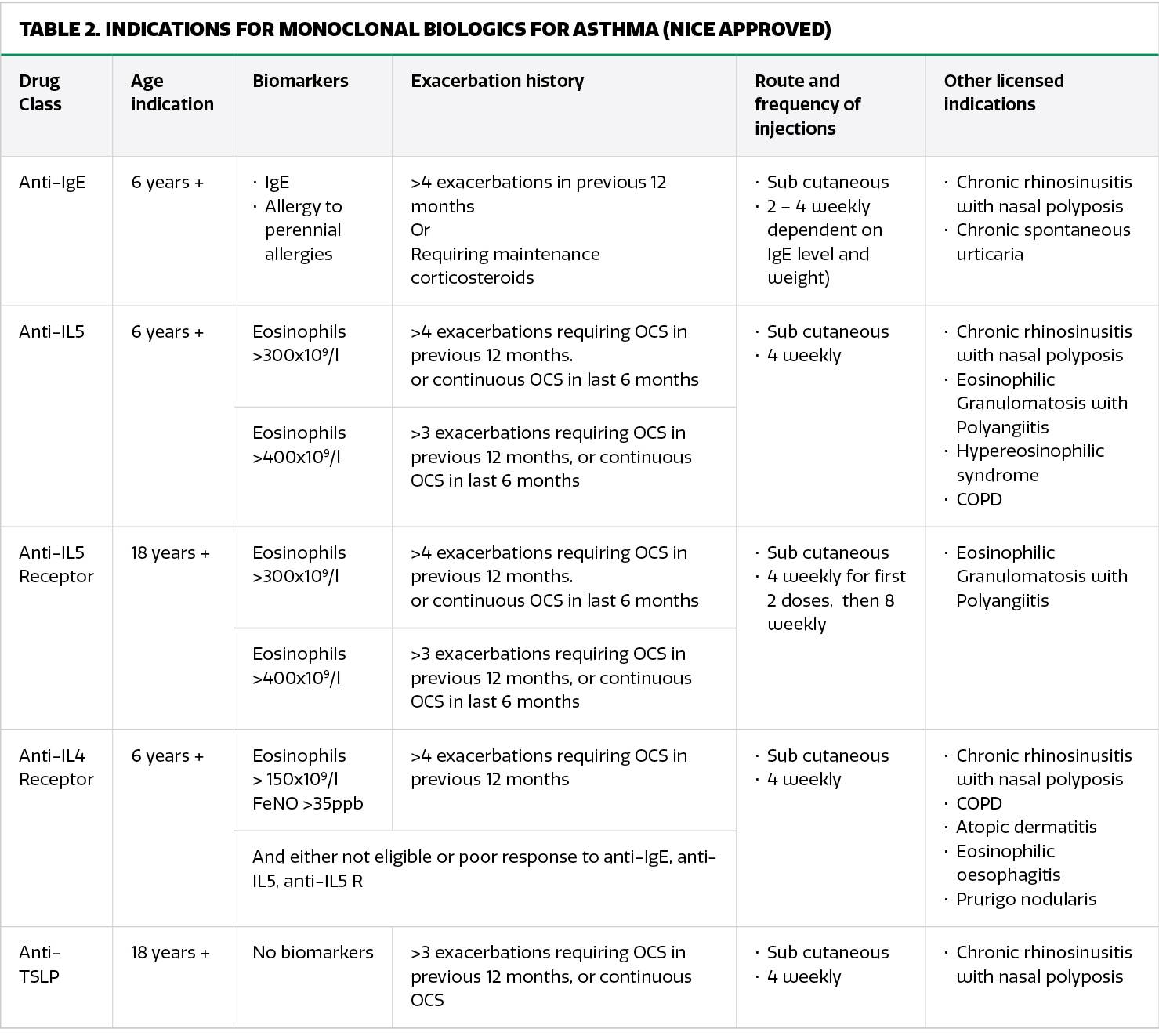
This is achieved through reviewing exacerbation history and biomarkers, to ensure the patient meets the NICE criteria for the drug, and considering any additional licence indications for each drug, that may impact on co morbidities e.g. nasal polyposis or dermatitis.As the frequency of dosing varies from 2 weekly to 8 weekly, patient preference should also be considered.
In the majority of cases, biologics are self-administrated at home with support from severe asthma team and home care companies.
Following assessment by the severe asthma team, patients will be discussed at a MDT meeting, where a management plan will be formulated and agreed. This plan may include optimisation of inhaled treatment, addressing adherence and underlying psychological issues, and the management of treatable traits. This is when the decision to trial a monoclonal biologic will be approved.
This process can be demonstrated by reviewing the results of the outcome of Robert’s systematic assessment (Case Study 2), where he was diagnosed with eosinophilic asthma. The physiotherapy assessment highlighted that he had experienced episodes of hyperventilation. Based on his biomarkers and exacerbation history, he is eligible for more than one monoclonal biologic: an anti-IL5, anti-IL5 receptor, and anti-TLSP. As he is monoclonal biologic naïve, he does not meet the criteria for an anti-IL4 receptor biologic. He has nasal polyposis and therefore an anti-IL5, which may improve his nasal disease, was selected.
In cases where a patient needs maintenance OCS to control their symptoms, the management plan would also include guidance on reducing the dose, with careful monitoring of symptoms and observation for signs of adrenal suppression.
If a patient has T2-low asthma and is not eligible for monoclonal biologics, alternative treatment options include the management of comorbidities such as smoking cessation, a structured exercise programme and weight management.A trial of a low dose of azithromycin, a macrolide antibiotic which has antibacterial, anti-inflammatory and immunomodulatory properties, may be recommended as it can reduce exacerbations and improve quality of life.18 This group of patients will usually continue to be reviewed and supported by the SAS.
The continual process of assessment, adjustment of treatment and reviewing symptoms to achieve asthma control (Figure 1) continues in managing severe asthma, with patients being reviewed and assessed by the SAS, to ensure that patients commenced on monoclonal biologics are achieving the clinical outcomes stipulated by NICE, which include:
- Reduction in exacerbations
- Reduction in the requirement for OCS
- Improvement in quality of life.
Patients are discussed at the MDT meeting at the end of their trial period and annually thereafter, to assess their response to the biologic and continued management of comorbidities.A decision will be made to continue with the prescribed biologic, if the NICE clinical outcomes have been achieved, to switch to another biologic, or to discontinue biologics completely, if the response has been suboptimal. Ongoing review and optimisation of the management of comorbidities are also critical to achieving optimal symptom control and risk reduction.
Patients who do not met the NICE criteria for biologics will usually continue to be reviewed and supported by the SAS.
Robert was discussed at the MDT meeting, 12 months after starting an anti-IL5 biologic. He demonstrated a good clinical response to treatment, with improvement in his symptom control (ACT 21), minimal use of SABA and no requirement for OCS, so continuation was approved.
Conclusion
Asthma management requires a continual process of assessment, adjustment and review to achieve the best possible outcomes for patients. This enables poor symptom control to be identified and explored. In many cases, this can be addressed by good asthma care delivered by nurses.
However, a relatively small number proportion of patients will have uncontrolled symptoms, despite inhaled ICS and LABA and are at risk of exacerbations and developing significant comorbidities and complications.
These patients need to be identified and referred to the SAS for assessment for advanced treatments and special interventions. Using a personalised approach in the diagnosis and management of severe asthma, improvement in asthma control and reducing the future risk of complications is achievable, as monoclonal biologics are transforming the lives of people living with severe asthma.
References
- Bateman ED, Hurd SS, Barnes PJ, et al. Global strategy for asthma management and prevention: GINA executive summary. Eur Respir J 2008;31:143–178.
- Cumella A, and Renwick L. Living in Limbo: the scale of unmet need in difficult and severe asthma. Asthma UK; 2019. https://www.asthmaandlung.org.uk/sites/default/files/2023-03/living-in-limbo---the-scale-of-unmet-need-in-difficult-and-severe-asthma.pdf
- Office of National Statistics.Deaths from asthma, respiratory disease, chronic obstructive pulmonary disease and flu, England and Wales, 2001-2018 occurrences; 2020. https://www.ons.gov.uk/peoplepopulationandcommunity/birthsdeathsandmarriages/deaths/adhocs/11241deathsfromasthmarespiratorydiseasechronicobstructivepulmonarydiseaseandfluenglandandwales20012018occurrences
- Royal College of Physicians (RCP). Why asthma still kills: National Review of Asthma Deaths;2014. https://www.rcp.ac.uk/media/i2jjkbmc/why-asthma-still-kills-full-report.pdf
- Global Initiative for Asthma (GINA). Global strategy for asthma management and prevention; 2026. https://ginasthma.org/2026-gina-strategy-report/ (https://ginasthma.org/2026-gina-strategy-report/)
- Gruffydd-Jones K, Thomas M, Roman-Rodriguez M, et al. Asthma impacts on workplace productivity in employed patients who are symptomatic despite background therapy: a multinational survey. Asthma Allergy 2019 Jul 11;12:183–194.
- Johnston S, Spin P, Connolly F, et al. Asthma and Attendance in Urban SchoolPrev Chronic Dis 2019 Oct 31:16:E148.
- Nathan RA, Sorkness CA, Kosinski M, et al. Development of the asthma control test: a survey for assessing asthma control. J Allergy Clin Immunol. 2004 Jan;113(1):59-65.
- Bloom CI, Cabrera C, Arnotorp S, et al. Asthma-Related Health Outcomes Associated with Short-Acting β2-Agonist Inhaler Use: An Observational UK Study as Part of the SABINA Global Program. Adv Ther. 2020;37(10):4190-4208.
- Sweeney J, Patterson C, Menzies-Gow A (2016) Comorbidity in severe asthma requiring systemic corticosteroid therapy: cross-sectional data from the Optimum Patient Care Research Database and the British Thoracic Difficult Asthma Registry. Thorax 2016;71:339–346
- Price D, Trudo F, Voorham J, et al (2018. Adverse outcomes from initiation of systemic corticosteroids for asthma: long-term observational study. J Asthma Allergy 2018;11:193-204.
- Melani AS, Bonavia M, Cilenti V, et al. Inhaler mishandling remains common in real life and is associate with reduced disease control. Respir Med 2011;105:930-938
- Ernst P, Spitzer WO, Suissa S, et al. Risk of fatal and near fatal asthma in relation to inhaled corticosteroid use. JAMA 1992;268:3462-3464
- NICE NG245. Asthma: diagnosis, monitoring and chronic asthma management (BTS, NICE, SIGN); last updated October 2024. https://www.nice.org.uk/guidance/NG245
- Centre of Excellence in Severe Asthma. Severe Asthma Toolkit; 2018. https://toolkit.severeasthma.org.au/co-morbidities/overview/
- Pinnock H, Parke HL, Pagagioti M, et al. Systematic meta review of supported self-management for asthma: a healthcare perspective. BMC Med 2017 15:64
- AHSN Health Innovation Oxford. Transferring asthma care through improved access to diagnostics and innovative treatments; 2023. https://www.healthinnovationoxford.org/our-work/respiratory/asthma-biologics-toolkit/
- Gibson P, Yang I, Upton K. Effect of azithromycin on asthma exacerbations and quality of life in adults with persistent uncontrolled asthma (AMAZES): a randomised, double-blind, placebo-controlled trial. Lancet 2017; 390(10095):659-668
Related articles
View all Articles